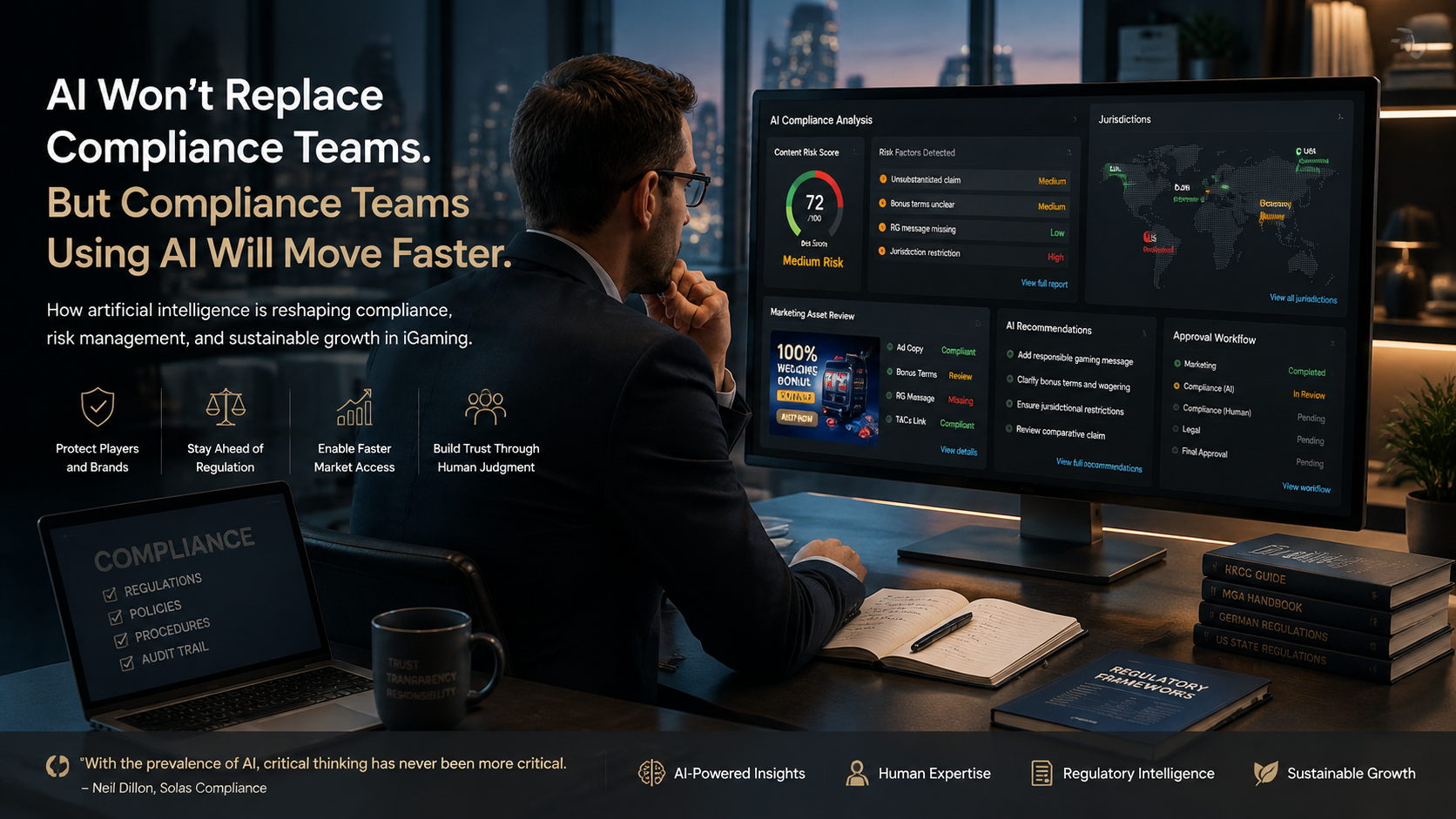
How artificial intelligence is changing the future of compliance in regulated iGaming
Artificial intelligence is rapidly changing the way regulated industries operate. In iGaming, where companies must balance commercial growth with strict regulatory requirements, AI creates both opportunities and new challenges.
Marketing teams can now create more content, faster than ever before. Operators are expanding into more jurisdictions. Regulatory expectations continue to increase. This creates a fundamental question: how can regulated companies increase speed without increasing risk?
According to Neil Dillon, CEO & Founder of Solas Compliance, the future is not about replacing compliance professionals with artificial intelligence. It is about giving compliance teams better tools to make better decisions.
> "With the prevalence of AI, critical thinking has never been more critical." — Neil Dillon, CEO & Founder of Solas Compliance
For an industry built around trust, regulation and player protection, this may become one of the defining questions of the next few years.
The old compliance model is struggling in the AI era
Traditionally, the workflow inside many regulated businesses looked like this: marketing creates content, compliance reviews it, and compliance approves or rejects it. This model worked when the amount of content was manageable. But AI has changed the scale completely.
Today, marketing teams can create advertising concepts, social media campaigns, promotional materials, affiliate content and customer communications at a speed that was impossible before. The problem is that compliance processes in many companies remain largely manual.
AI is accelerating content creation. Compliance needs to accelerate decision-making. The challenge is not that compliance has become less important — it is that companies need new ways to maintain control while operating at a much higher speed.
AI should support human judgment, not replace it
One of the biggest misconceptions around AI is that companies must choose between automation and human expertise. The reality is different.
AI can help compliance teams review large volumes of content, identify potential risks, compare materials against regulations, monitor changes, create audit trails and improve internal workflows. But regulated industries cannot simply outsource responsibility to technology.
The key question is not only "what answer did AI provide?" but "why did AI provide this answer?" This is where human expertise remains critical. A compliance decision often depends on market context, regulatory interpretation, customer behaviour, company risk appetite and previous enforcement actions.
> "Confidence is not the same as correctness." — Neil Dillon, CEO & Founder of Solas Compliance
The more powerful AI systems become, the more important critical thinking becomes.
From compliance as a blocker to compliance as a growth function
For many years, compliance has often been viewed as a department that slows business down. Marketing wants to move faster, product teams want innovation, commercial teams want growth — and compliance asks more questions. This creates friction.
However, AI has the potential to change this relationship. Instead of compliance entering at the end of the process, it can become part of the process from the beginning. A future workflow could look different: a marketing team creates a campaign, AI reviews potential issues immediately, teams fix problems earlier, and compliance focuses on complex decisions that require expertise.
The result: fewer delays, fewer revisions, faster launches and lower regulatory risk. Compliance stops being the function that only says "no". It becomes a function that helps companies move faster with confidence.
Why AI compliance is becoming a business issue
One of the biggest changes is that AI compliance affects multiple departments. For marketing teams, the priority is speed — they want to launch campaigns faster and reduce unnecessary rework. For compliance teams, the challenge is scale — they need to review more material without becoming a bottleneck. For leadership teams, the priority is risk management — they need confidence that the company can demonstrate a strong process if regulators ask questions.
This is why AI compliance is becoming a business infrastructure topic, not just a compliance topic.
Different markets, different rules
One of the biggest challenges in iGaming is that compliance is never universal. The UK is different from Germany. Germany is different from Malta. Europe is different from the US.
Operators expanding internationally need to manage different advertising rules, different responsible gaming requirements, different AML expectations and different regulatory interpretations. This means AI compliance systems cannot simply be generic tools — they need to understand jurisdiction-specific regulations, internal company policies, brand guidelines, regulatory decisions and company risk appetite.
The future of AI compliance will depend not only on technology, but on the quality of knowledge behind it.
Buy versus build: the strategic AI question for operators
Many large operators are asking the same question: should we build our own AI capabilities internally, or should we work with specialised technology providers?
Building AI systems requires data, engineering resources, testing, governance and continuous improvement. AI is not something companies simply activate — it requires ongoing optimisation. For many operators, the question becomes whether AI compliance is a core competitive advantage they need to build themselves, or a specialised capability where working with experts creates more value.
The future compliance professional will be AI-native
AI will not eliminate the need for compliance professionals, but it will change their role. The strongest compliance specialists of the future will understand both regulation and technology. They will know where AI is reliable, where AI creates risk, how to challenge AI decisions and how to use technology responsibly.
Compliance teams may become more efficient and potentially smaller in some areas, but their strategic importance will increase. The future compliance professional will not compete with AI — they will know how to use it better than others.
The future of compliance is trust infrastructure
The biggest lesson from the AI discussion is that technology alone is not enough. Successful regulated companies will need a combination of AI capability, human expertise, strong governance, transparent decision-making and regulatory understanding.
The future is not AI replacing people. The future is AI helping people make better decisions faster. For regulated iGaming, this distinction is critical — because compliance is not only about avoiding problems, it is about building the trust infrastructure that allows companies to grow sustainably.
About Neil Dillon
Neil Dillon is CEO & Founder of Solas Compliance, an AI-powered compliance technology company focused on helping regulated businesses improve marketing compliance, governance and operational efficiency.
Source: Solas Compliance

Alex Bilyi
Senior Editor
Member of the iGaming Pulse editorial team. Covering industry news, analysis, and B2B developments across the global iGaming sector.