DraftKings Deploys Geographic Separation to Manage Prediction Market Strategy
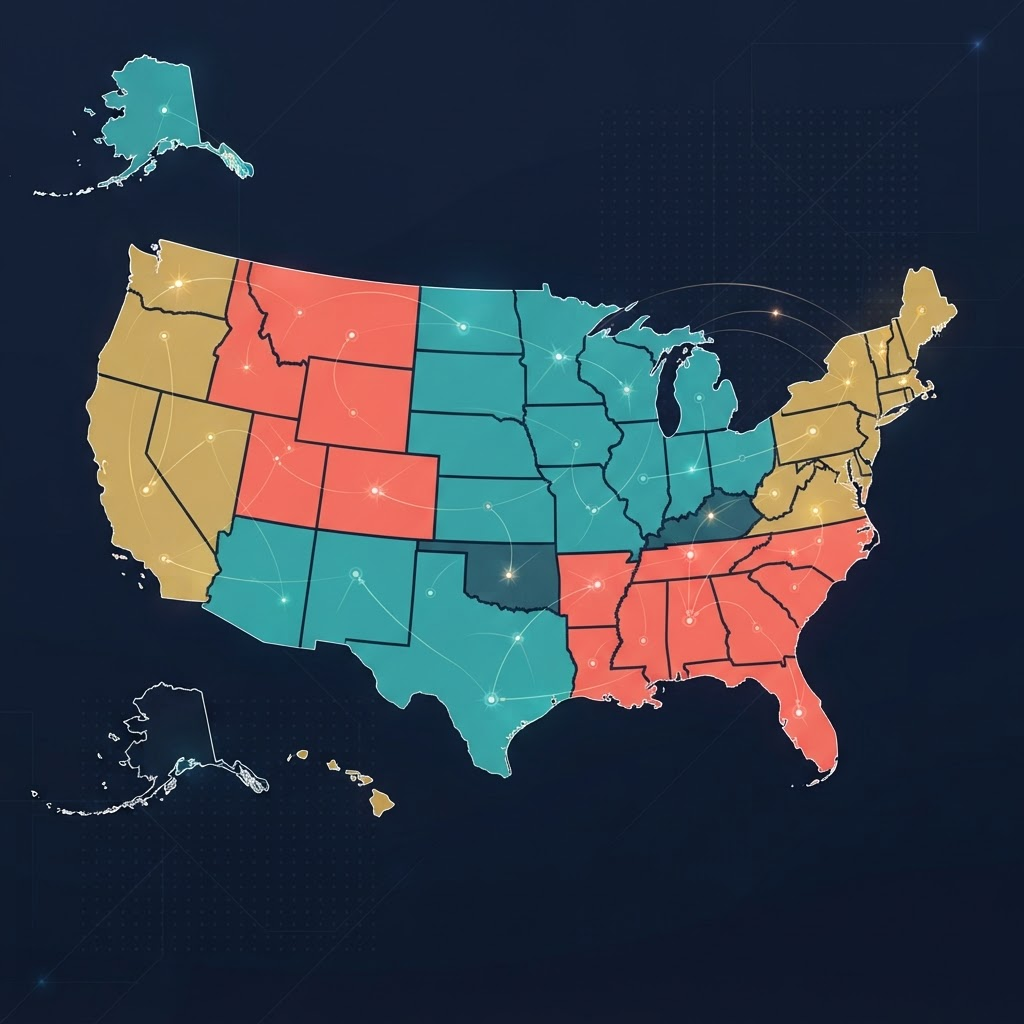
DraftKings has engineered a clear geographic divide between its prediction market and sportsbook operations, offering sports event contracts in exactly 18 states where it holds no online sportsbook license while maintaining zero prediction market presence across its 27 sportsbook jurisdictions.
The strategic architecture allows the operator to make seemingly contradictory claims: that prediction markets and sportsbooks are non-cannibalistic products to investors, that prediction market advertising never crosses promotional lines to the NFL, and that the two services operate as distinct business units to regulators.
The Map and the Message
The geographic separation isn't accidental. By design, customers in states with DraftKings sportsbooks cannot access prediction markets through the same account infrastructure, wallet, or platform ecosystem. Conversely, in states where DraftKings operates prediction markets—primarily smaller jurisdictions or those without existing sportsbook authorization—the operator maintains no competing sportsbook presence.
This compartmentalization provides regulatory cover across multiple fronts. When presenting to institutional investors, DraftKings can demonstrate mathematically that the products operate in mutually exclusive markets, with virtually no overlap in the customer bases that could theoretically cannibalize sportsbook revenue. The same logic applies to NFL advertising negotiations, where the league has expressed concerns about prediction market promotion potentially undercutting sportsbook legitimacy or creating confusion among consumers about approved betting products.
For state gaming regulators reviewing applications or evaluating whether multi-product operators require additional oversight, the geographic separation presents a simplified narrative: DraftKings is effectively operating two independent businesses with no direct competitive interaction.
What This Reveals About Market Dynamics
The deliberate segmentation underscores an unspoken reality in the prediction market debate: cannibalization is a genuine risk that operators take seriously enough to structure around it operationally. If prediction markets and sportsbooks were truly non-competitive products serving entirely different customer segments, DraftKings would have no strategic reason to maintain this geographic wall.
Instead, the company appears to be hedging against the possibility that they do compete. By preventing cannibal ization in sportsbook-heavy states—where established customer bases and revenue streams are largest—DraftKings protects its core business model while still capturing prediction market upside in underserved jurisdictions.
The strategy also allows DraftKings to avoid a more difficult conversation: whether prediction markets, with their real-time price discovery and event outcome trading mechanics, actually function as a superior or complementary product for certain user segments compared to traditional sports betting. Geographically separating the products keeps that question off the table.
Competitive and Regulatory Implications
Other operators watching DraftKings' approach face a decision point. Competitors like FanDuel and Caesars could pursue similar geographic segmentation strategies, or they could attempt to build prediction market presence in core sportsbook states through brand separation or different regulatory licensing structures.
Regulators in prediction-market-friendly states like California and New York will likely begin reviewing whether geographic separation should be a requirement or expectation for multi-product operators. The question becomes whether compartmentalization actually protects consumers or simply obscures cannibalization effects that occur at the customer data and marketing level even when products are geographically separated.
For the broader industry, DraftKings' approach demonstrates how operators are learning to thread the regulatory needle—acknowledging product differences to various stakeholders while maintaining operational flexibility that allows them to pivot if market conditions or regulatory pressure shifts.
Source: Gambling Insider
Marcus De Luca
Regulation Correspondent
Member of the iGaming Pulse editorial team. Covering industry news, analysis, and B2B developments across the global iGaming sector.