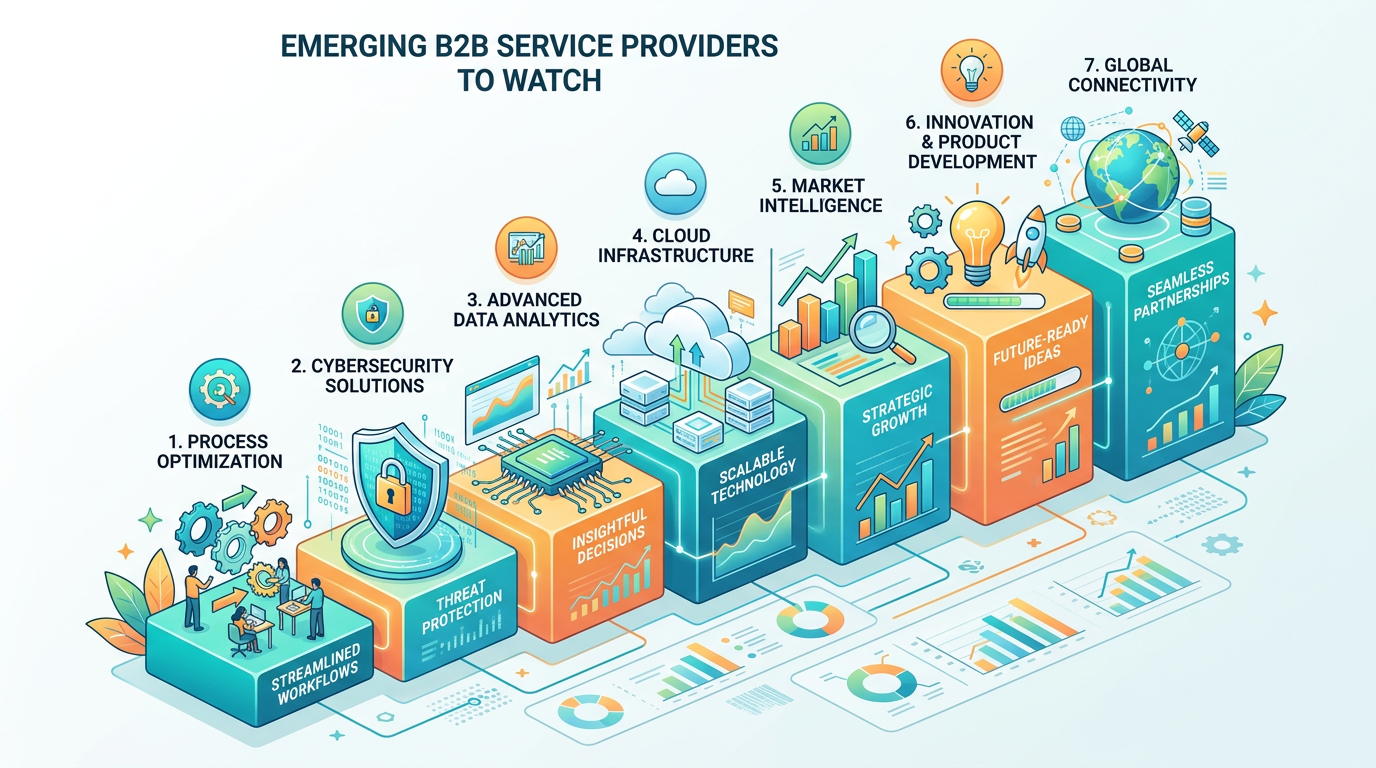
The B2B side of iGaming is changing faster than the operator side. While household-name platforms and studios still take the biggest share of contracts, a new tier of emerging B2B iGaming service providers is winning attention in 2026 by solving narrow, expensive problems very well: micro-betting, AI-driven CRM, identity verification, payments and fresh game content. For operators planning next year's vendor stack, these are the names worth watching.
This listicle profiles seven providers that are either newly scaling, recently funded or pushing into new product categories. The selection is editorial: none of the companies below paid for inclusion, and the list mixes younger specialists with fast-evolving businesses that are redefining their category.
Quick Summary: 7 B2B iGaming Providers to Watch in 2026
| # | Provider | Category | Why it matters in 2026 | Best fit for |
|---|---|---|---|---|
| 1 | Kero Sports | Micro-betting / in-play | Real-time micro-markets distributed via major sportsbook platforms | Sportsbooks chasing live engagement |
| 2 | Fast Track | CRM & player engagement | Agentic AI workflows for CRM teams | Operators with lean CRM teams |
| 3 | Hub88 | Game aggregation | Aggressive onboarding of new studios in 2026 | Casinos wanting broad content via one API |
| 4 | Sumsub | KYC / AML / fraud | Unified verification and fraud stack across 220 countries | Multi-jurisdiction operators |
| 5 | Payper | Payments | Market-specific payment rails for regulated North America | Operators entering Canada |
| 6 | Whoah Labs | Casino content | New global distribution footprint | Casinos refreshing slot lobbies |
| 7 | Gametimetec | Casino content | Show-style slot concepts reaching aggregators | Brands seeking differentiated titles |
How We Selected These Providers
To keep the list useful for B2B buyers rather than a popularity contest, each company was assessed against four criteria:
- Momentum in 2025–2026. New funding, significant distribution deals or major product releases within the last 12–18 months.
- Problem focus. A clear answer to a costly operator pain point — retention, compliance, payments or content fatigue.
- Integration reach. Availability through aggregators, platforms or standard APIs, so adoption does not require a months-long custom build.
- Regulated-market readiness. Evidence that the product is built to work under licensing regimes, not only in grey markets.
Market-share figures for private B2B suppliers are rarely disclosed, so where we reference scale we use company-reported numbers and treat them as indicative.
1. Kero Sports — Micro-Betting Built for Live Sport
Kero Sports (formerly known as Kero Gaming) builds a real-time micro-betting engine that generates fast, contextual in-play markets — next play, next pitch, next drive outcome — for sportsbooks, teams and leagues. The company closed a reported $3 million funding round in 2025, with SIG Sports among the backers, according to NEXT.io.
Distribution is the real story. Kero's micro-markets have been integrated into EveryMatrix's OddsMatrix sportsbook and made available to Bragg Gaming Group's aggregation customers, while Caesars has used Kero-powered live betting in the US. That means operators can access the product through platforms they already use.
Why watch it: micro-betting is one of the few sportsbook formats that increases session frequency during a live event rather than just margin per bet. Expect more platform partnerships as US and Canadian operators compete on live engagement.
2. Fast Track — CRM Moves to Agentic AI
Fast Track is a Swedish software group behind an iGaming-specific CRM and player engagement platform. Its product history maps the evolution of CRM in the sector: real-time CRM in 2018, the AI-based Singularity personalisation model in 2021, gamified Rewards in 2024 and a natural-language interface in 2025.
In 2026 the company moved to agentic workflows, allowing CRM teams to run segmentation, trigger configuration, message drafting and multi-channel campaign setup through natural-language instructions, as reported by iGaming Business. Fast Track has also added tournaments to its Rewards suite.
Why watch it: CRM headcount is one of the largest fixed costs for mid-sized operators. If agentic tools deliver even part of their promise, a two-person retention team could run campaign volumes that previously required five or six specialists.
3. Hub88 — The Aggregator Doubling Down on New Studios
Hub88, part of Yolo Group and headquartered in Tallinn, provides single-API access to a library it describes as more than 12,000 games from over 100 developers, alongside back-office tools for bonuses, payments and business intelligence.
What makes Hub88 relevant to this list is its role as a launchpad for emerging content. In August 2026 alone it announced a global distribution agreement with Whoah Labs and an integration bringing Gametimetec's Showtime Slots to its operators. For young studios, securing an aggregator of this reach is often the difference between a handful of casino partners and hundreds.
Why watch it: the aggregator battleground is shifting from sheer game count to operational control — curation, lobby tools and data. Hub88's pace of studio onboarding suggests it intends to compete on discovery of new content, not just volume.
4. Sumsub — Verification and Fraud in One Stack
Sumsub is not a start-up, but its iGaming business has expanded rapidly enough to deserve attention. The company positions a single API call as triggering identity verification, document checks, AML screening, device intelligence and risk scoring together, with coverage across 220 countries and territories.
The fraud layer targets the problems operators actually lose money to: bonus abuse, multi-accounting, deepfake onboarding attempts and account takeovers. The company reports working with roughly 400 iGaming operators, and identity-verification friction remains a well-documented cause of abandoned registrations across the sector.
Why watch it: regulators in the UK, Europe and Latin America are tightening affordability and age-verification requirements. Vendors that can combine compliance with low-friction onboarding will increasingly be treated as conversion tools, not just compliance costs.
5. Payper — Payments Tailored to Regulated North America
Payper is a Canada-focused payments provider serving gaming and other high-risk verticals. Its value lies in local payment rails and processing designed for the Canadian market, where Ontario's regulated iGaming framework has attracted dozens of licensed operators since 2022.
Payment acceptance is one of the most underestimated barriers to market entry. International operators frequently discover that global PSPs do not deliver the approval rates or local methods Canadian players expect, making specialist regional providers a meaningful lever on first-time deposit conversion.
Why watch it: as more Canadian provinces debate regulated online gaming, demand for locally optimised payment partners is likely to grow. Payper represents a broader trend of payment specialists winning on market depth rather than global breadth.
6. Whoah Labs — A New Content Studio Going Global
Whoah Labs is one of the newer casino content studios to secure broad distribution in 2026, signing a global distribution agreement with Hub88 in August. For a young studio, that deal places its titles in front of a large base of operators through a single integration.
Detailed performance data for new studios is rarely public, so operators should judge Whoah Labs on the metrics that matter in their own lobbies: retention on day one and day seven, average session length and how the games perform in promotional placements.
Why watch it: slot lobbies across Europe and LatAm are saturated with near-identical mechanics. Operators consistently say they want distinctive content; studios like Whoah Labs are betting that fresh design can cut through.
7. Gametimetec — Show-Style Slots for Differentiation
Gametimetec is pushing its Showtime Slots concept to a wider audience after its integration with Hub88 was announced in August 2026. The positioning is entertainment-led content designed to stand apart from standard reel-based games.
Like other emerging studios, Gametimetec's long-term success will depend on proving player retention in live environments rather than on launch-day novelty. Operators should consider trialling titles in dedicated "new and exclusive" lobby sections and measuring against their existing top ten.
Why watch it: entertainment-led formats have been one of the few content categories to break through in recent years, from crash games to game-show live titles. Studios that combine that spirit with RNG economics could carve out a profitable niche.
Top Pick by Operator Need
- For sportsbooks: Kero Sports offers the most direct path to higher live-event engagement, particularly for North American operators.
- For retention teams: Fast Track's agentic CRM is the clearest bet on productivity gains.
- For casino content breadth: Hub88 remains the most efficient way to access emerging studios, including Whoah Labs and Gametimetec.
- For compliance and fraud: Sumsub combines verification and fraud tooling in one integration.
- For Canadian market entry: Payper addresses a payment gap that global PSPs often leave open.
FAQ
What counts as an emerging B2B iGaming service provider? An emerging provider is a supplier that is either relatively young, recently funded or moving rapidly into a new category. In this list, we include established firms such as Sumsub when their iGaming-specific offering is scaling quickly, alongside newer studios and specialists that secured major distribution in 2025–2026.
How should operators evaluate a new B2B iGaming supplier? Start with licensing and certification status in your target markets, then check integration routes — ideally via an existing platform or aggregator. Request references from comparable operators, agree clear performance KPIs for a pilot period, and confirm data-protection and incident-response commitments before signing a long-term contract.
Are emerging iGaming providers riskier than established ones? They can carry higher delivery and continuity risk, particularly around support capacity and financial runway. However, many now reach operators through established aggregators and platforms, which reduces integration risk. A staged rollout with clear exit terms lets operators capture the upside of innovation while limiting exposure.
Which B2B iGaming categories are growing fastest in 2026? Based on deal flow and product launches this year, the most active categories are AI-driven CRM and personalisation, micro-betting and live sportsbook products, identity verification and fraud prevention, and localised payments for newly regulated markets. Content remains competitive, with differentiation rather than volume now the key selling point.
Conclusion
The emerging B2B iGaming service providers worth watching in 2026 have one thing in common: they target a specific, measurable operator problem instead of trying to be a full-stack platform. For most operators, the practical move is not to replace core vendors but to pilot one or two specialists in the areas where the current stack is weakest — live engagement, CRM productivity, onboarding friction or local payments — and scale only what proves itself in the numbers.
Source: iGaming Pulse Editorial Desk

Illia Lisovskyy
Senior Editor
Member of the iGaming Pulse editorial team. Covering industry news, analysis, and B2B developments across the global iGaming sector.