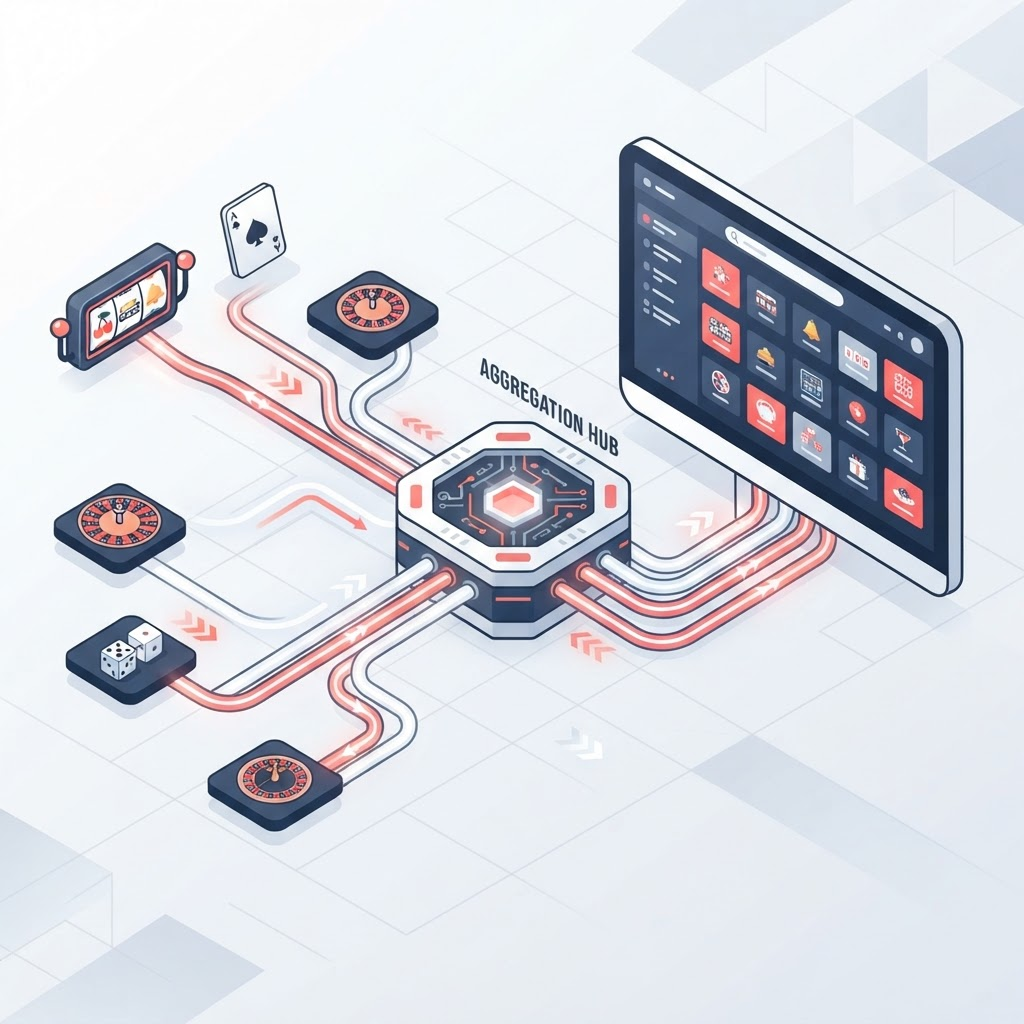
What Game Aggregation Actually Means
Game aggregation is the layer of infrastructure that sits between an online casino operator and the hundreds of studios that build slots, live dealer tables, and crash games. Instead of negotiating and technically integrating with each studio one by one, an operator connects once to an aggregator's API and gains access to the studios already plugged into that hub. For a B2B buyer evaluating platform vendors, understanding how this layer works — and where it can go wrong — is the difference between a six-week launch and a six-month one.
The category exists because direct integration doesn't scale. A single slot studio integration involves a commercial contract, a technical certification process, a compliance review per jurisdiction, and ongoing maintenance as the studio ships new titles. Multiply that by 50 or 300 providers and the operational load becomes the actual bottleneck to launching a competitive casino — not marketing, not payments, but content plumbing.
Why B2B Buyers Care About This Layer Specifically
Game aggregation decisions get made once and lived with for years, because switching aggregators later means re-certifying content, re-negotiating revenue share, and risking downtime on live game feeds. That makes it one of the higher-stakes technical procurement decisions an operator makes, alongside choosing a platform provider or a payment orchestration layer.
The commercial logic is straightforward: aggregators reduce integration timelines that would otherwise run 6–9 months for multiple direct provider connections down to roughly 4–6 weeks through a single unified pipeline. That compression matters most for operators entering new markets under time pressure — a license just approved, a marketing budget already committed, a launch date already announced.
How the Aggregation Model Works, Step by Step
1. The aggregator signs distribution agreements with studios
An aggregator's core asset is its network of signed distributor agreements with game studios — not the technology itself, which is comparatively commoditized. SoftSwiss, for example, connects operators to 40,000+ games from 300+ verified providers through a single API, having done the contractual work with each studio in advance. EveryMatrix has built what it describes as the largest casino content aggregator on the market, streaming content from over 350 premium providers through its CasinoEngine platform.
2. The operator integrates once, against a single API
Rather than building and maintaining separate technical connections per studio (each with its own request formats, session handling, and reporting), the operator implements one API specification. Slotegrator's APIgrator solution follows this model, giving operators access to 30,000+ certified games from 180+ licensed providers through a single integration session — the company states the fastest integrations can be completed in as little as 24 hours once compliance requirements are cleared.
3. Content and studios are managed from a back office
Post-integration, the operator doesn't get all content switched on by default. A back-office layer lets operators select which studios and individual games to activate per brand or per market, since not every title is licensed for every jurisdiction. This is also where analytics on game performance by market typically live, informing which content mix to expand or cut.
4. Compliance and certification are checked per jurisdiction
This is the step buyers most often underestimate. A game certified for the Malta Gaming Authority isn't automatically cleared for Ontario or a Curaçao-licensed brand's other markets. Aggregators vary in how much of this compliance mapping they handle versus leave to the operator — a gap worth probing directly in a vendor call rather than assuming from marketing copy.
5. Revenue share and reporting flow back through the aggregator
The aggregator typically sits in the commercial and reporting chain too, consolidating GGR reporting across dozens of providers into one dashboard and handling the revenue-share settlement with each studio, rather than the operator reconciling 50 separate statements.
Aggregator vs. Direct Integration: Quick Comparison
| Factor | Aggregator | Direct Studio Integration |
|---|---|---|
| Time to add a new provider | Days to weeks | Months per studio |
| Contracts to manage | One (aggregator) | One per studio |
| Compliance mapping | Partially handled, varies by vendor | Fully on the operator |
| Reporting | Consolidated across providers | Reconciled manually per studio |
| Content breadth at launch | Immediate access to full network | Grows one deal at a time |
| Negotiating leverage on revenue share | Lower per-studio, higher volume | Higher per-studio, but slower to scale |
| Best fit | New launches, multi-market operators, fast content expansion | Operators anchoring around one flagship studio relationship |
The trade-off is not free content breadth versus cost — most operators pay for both models in different forms, either through aggregator margin or through the internal engineering headcount that direct integration requires.
How Aggregators Actually Get Paid
Understanding the commercial model helps explain why aggregator pitches emphasize catalogue size so heavily. Aggregators typically earn a margin on the revenue share that flows from studio to operator — the studio sets its standard GGR percentage, and the aggregator takes a cut for the contractual, technical, and reporting work of bundling that studio into its network. This means the aggregator's incentive is aligned with adding as many studios as possible, since each new provider is a new revenue line, not necessarily with curating the highest-performing subset for any one operator's specific market.
This is not a criticism of the model so much as a reason for buyers to ask pointed questions during procurement: what does the fee structure look like beyond the headline revenue share, are there minimum volume commitments, and does the aggregator charge separately for compliance support or treat it as included. Contract terms vary enough between SoftSwiss, EveryMatrix, and Slotegrator that a side-by-side breakdown of total cost — not just the advertised game count — is worth building before shortlisting narrows to one vendor.
Common Mistakes B2B Buyers Make When Evaluating Aggregators
Assuming "40,000 games" means 40,000 relevant games. Raw catalogue size is a weak signal on its own. A large chunk of any aggregator's library will be low-performing or market-irrelevant titles. Ask for a breakdown by top-performing studios in your target markets, not the total count.
Not checking studio overlap before switching. Operators moving between aggregators sometimes assume they'll keep the same top-performing studios. Provider agreements are between the aggregator and the studio, not portable to the operator, so confirm which specific studios are actually on the new aggregator's network before signing.
Underestimating the compliance handoff. Treating "certified games" as a blanket statement rather than a per-jurisdiction one is one of the most common gaps that surfaces after launch, typically as a delayed market entry rather than a technical failure.
Ignoring the exit terms. Aggregation contracts are easy to enter and comparatively hard to leave without content downtime. Buyers should ask specifically what a migration timeline looks like before they need one, not after.
Treating aggregator and platform provider as the same evaluation. Some vendors offer both a full casino platform and a game aggregation layer (EveryMatrix and SoftSwiss both do), while others are aggregation-focused with platform partnerships. Buyers should be clear on which piece they're actually procuring and whether bundling both with one vendor is a genuine efficiency or unnecessary lock-in.
Frequently Asked Questions
What's the difference between a game aggregator and a casino platform provider? A platform provider runs the core casino software — accounts, wallets, bonusing, the player-facing site. A game aggregator supplies and manages the game content layer. Some vendors, like SoftSwiss and EveryMatrix, offer both, but they're functionally separate decisions even when bought from one vendor.
How long does aggregator integration typically take? Vendors commonly cite 24 hours to a few weeks for the technical integration itself, but the realistic timeline including compliance checks, content selection, and testing tends to run 4–6 weeks for a straightforward single-market launch.
Can an operator use more than one aggregator at the same time? Yes, and larger multi-market operators frequently do, to maximize studio coverage or hedge against a single vendor's compliance gaps in a given jurisdiction. It adds integration and reporting overhead, so it's usually a decision made after outgrowing a single aggregator's coverage.
Does switching aggregators mean losing player-favorite games? Potentially, if the new aggregator doesn't carry the same studios. This is why confirming exact studio overlap — not just total game counts — should happen before any migration commitment, not during it.
Is a bigger game catalogue always the better choice? Not necessarily. Catalogue size is a proxy for negotiating reach, not for relevance to a specific operator's target markets. A smaller aggregator with strong coverage in an operator's actual licensed jurisdictions can outperform a larger one padded with content irrelevant to those markets.
The Bottom Line for Buyers
Game aggregation exists to compress a slow, contract-heavy integration problem into a single technical and commercial relationship. That compression is real and valuable, but it shifts risk rather than eliminating it: the buyer is now trusting one vendor's network breadth, compliance handling, and exit terms instead of managing many smaller direct relationships. Vendors like SoftSwiss, EveryMatrix, and Slotegrator each approach that trade differently in catalogue size, bundled platform services, and compliance support — the right fit depends on how many markets an operator is launching into and how much of the compliance mapping they're prepared to own internally. The practical next step for any buyer is a studio-overlap and jurisdiction-coverage comparison across shortlisted vendors before a single contract gets signed.
Original analysis by iGaming Pulse Editorial Desk. Published 2026-09-14.
Source: iGaming Pulse Editorial Desk

Illia Lisovskyy
Senior Editor
Member of the iGaming Pulse editorial team. Covering industry news, analysis, and B2B developments across the global iGaming sector.