Context
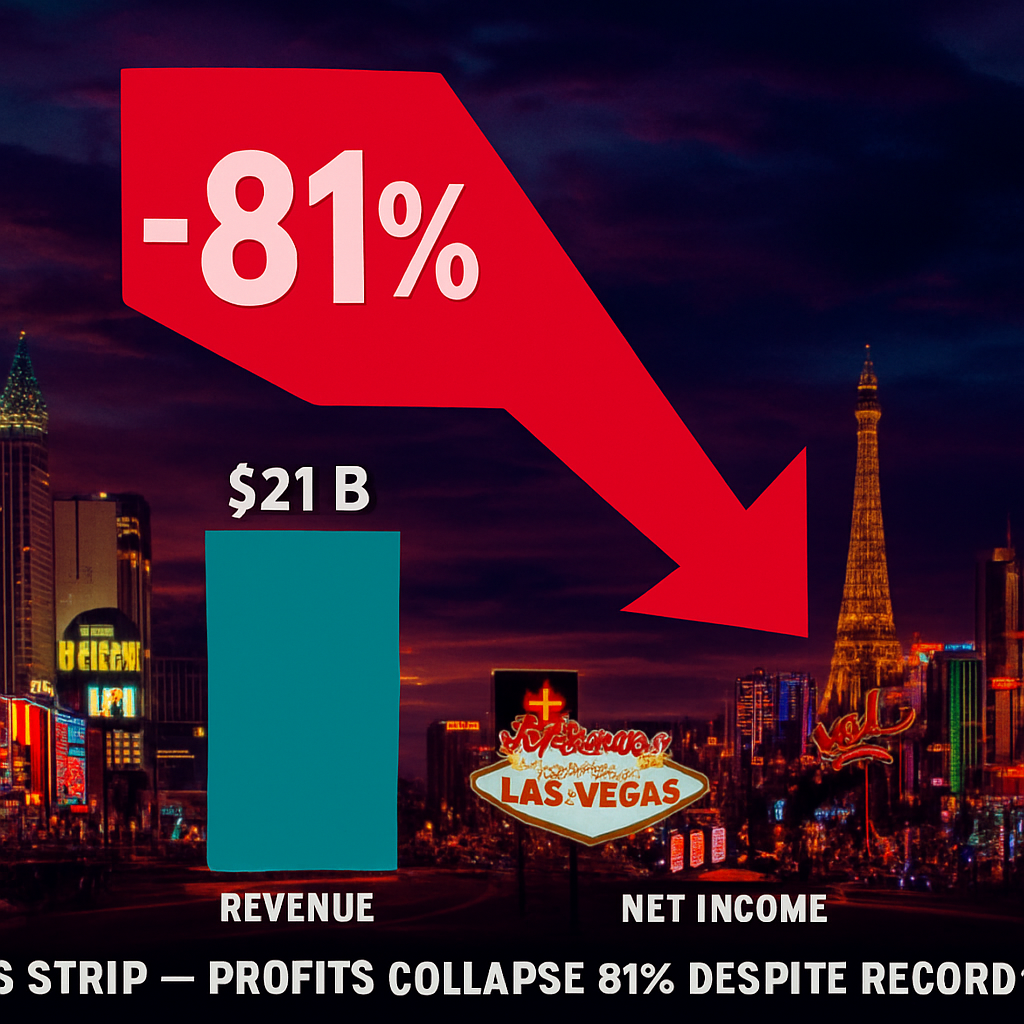
The Las Vegas Strip represents the crown jewel of regional gaming in North America, with integrated resort properties generating over $21 billion in annual revenue. Fiscal year 2025 presented a paradoxical situation: Strip operators achieved gaming revenue near all-time records at $21.08 billion, yet net income collapsed to just $154.2 million — a staggering 81.2% decline from prior year levels. This disconnect between revenue success and profit failure indicates that cost structure problems have fundamentally challenged Strip operator profitability.
What This Means
The Vegas Strip's profit collapse reflects several converging economic pressures:
Labour Cost Escalation: Post-pandemic wage inflation, union negotiations, and tight labour markets have driven significant increases in dealer, housekeeping, and service staff compensation. Major Strip unionised properties faced pressure to raise wages substantially to attract and retain workers in a competitive hospitality talent market.
Utility and Facility Costs: Inflation in electricity, water, and facility maintenance — particularly acute in Las Vegas's desert environment — has driven operational costs higher. Energy-intensive 24-hour casino operations face especially severe utility expense growth.
Debt Service: Many Strip properties carry substantial long-term debt from construction, expansion, or REIT restructuring. Rising interest rates have increased debt service costs, directly reducing net income from the operating line.
Non-Gaming Investment: Operators have aggressively expanded non-gaming amenities — entertainment venues, restaurants, retail — which generate revenue but require substantial ongoing investment and staffing that may not yet be fully profitable.
The implications extend beyond Las Vegas. If the world's most sophisticated, highest-revenue gaming market cannot translate record revenue into proportional profit, it raises serious questions about cost structure sustainability across the regional and national casino industry.
What to Watch
Monitor individual operator earnings reports for Q1 and Q2 2026 to determine whether the FY 2025 profit compression is improving or deteriorating. Operators who have successfully passed cost increases through to consumers via higher hotel rates, F&B prices, and gaming floor changes will show margin recovery. Those unable to do so face continued structural pressure despite revenue strength.
What this means for B2B outreach: Cost reduction and operational efficiency technology vendors — from gaming floor analytics to labour scheduling software and energy management systems — have a compelling, data-backed narrative for Strip properties. The 81% profit collapse despite record revenue is the most powerful possible argument for operational efficiency investment, and vendors with documented cost-reduction case studies should be actively engaging procurement teams.
Source: Casino.org. Published 2026-06-12.
Source: casino.org
Sofia Eriksson
Senior Reporter
Member of the iGaming Pulse editorial team. Covering industry news, analysis, and B2B developments across the global iGaming sector.