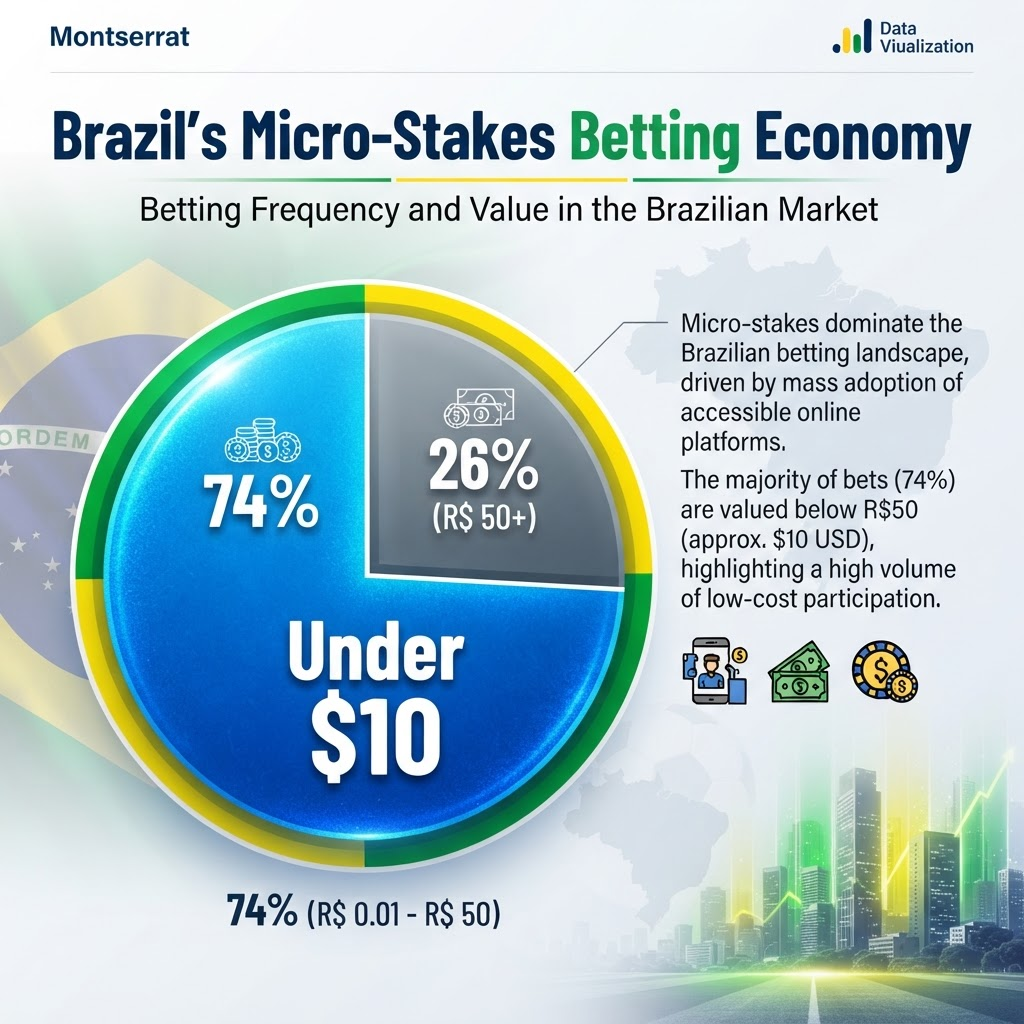
Micro-Stakes Economy Defines Brazilian Betting
A comprehensive market study conducted by Paag (Associação de Apostas do Brasil), released in July 2026, reveals a striking pattern in Brazilian sports betting behaviour: wagers of $10 or less accounted for 74% of all betting transactions during Q2 2026. This data point fundamentally challenges conventional Western betting operator economics and exposes the unique characteristics of Latin America's emerging sports betting market.
The micro-stakes finding reflects core structural realities of the Brazilian market: lower average consumer disposable income compared to North American and Western European markets, cultural preference for frequent small-stakes entertainment, and mobile-first accessibility driving lower-barrier entry to betting. The result is a market defined by transaction volume and engagement frequency rather than average bet value.
Platform Economics Hinged on Scale and Velocity
For Brazilian operators, the 74% micro-stakes figure means that profitability depends fundamentally on technology infrastructure capable of processing high-velocity, low-value transactions efficiently. Payment processing costs, fraud prevention overhead, and customer acquisition expenses must all be calibrated to work at scale—where margin per transaction is razor-thin but total transaction volume is enormous.
This structural reality creates distinct technology and operational requirements. Payment processing: micro-stakes transactions incur proportionally higher payment gateway fees, requiring operators to secure partnerships with payment providers offering competitive micropayment rates. Fraud prevention: the volume of micro-stakes transactions creates a proportionally larger attack surface for fraud, requiring sophisticated anomaly detection systems capable of distinguishing legitimate micro-stakes players from fraudulent automated bots.
For B2B technology providers targeting Brazil, the micro-stakes dominance creates specific product requirements around high-throughput transaction processing, real-time fraud detection at scale, and cost-efficient payment infrastructure optimised for small-value transactions.
Why It Matters
Brazil's micro-stakes betting dominance has profound implications for platform economics, customer lifetime value models, and payment processing. B2B service providers must understand that Brazilian operators depend heavily on transaction volume rather than average bet size, fundamentally altering technology infrastructure, fraud prevention, and customer retention strategies.
Source: iGaming Business
Sofia Eriksson
Senior Reporter
Member of the iGaming Pulse editorial team. Covering industry news, analysis, and B2B developments across the global iGaming sector.