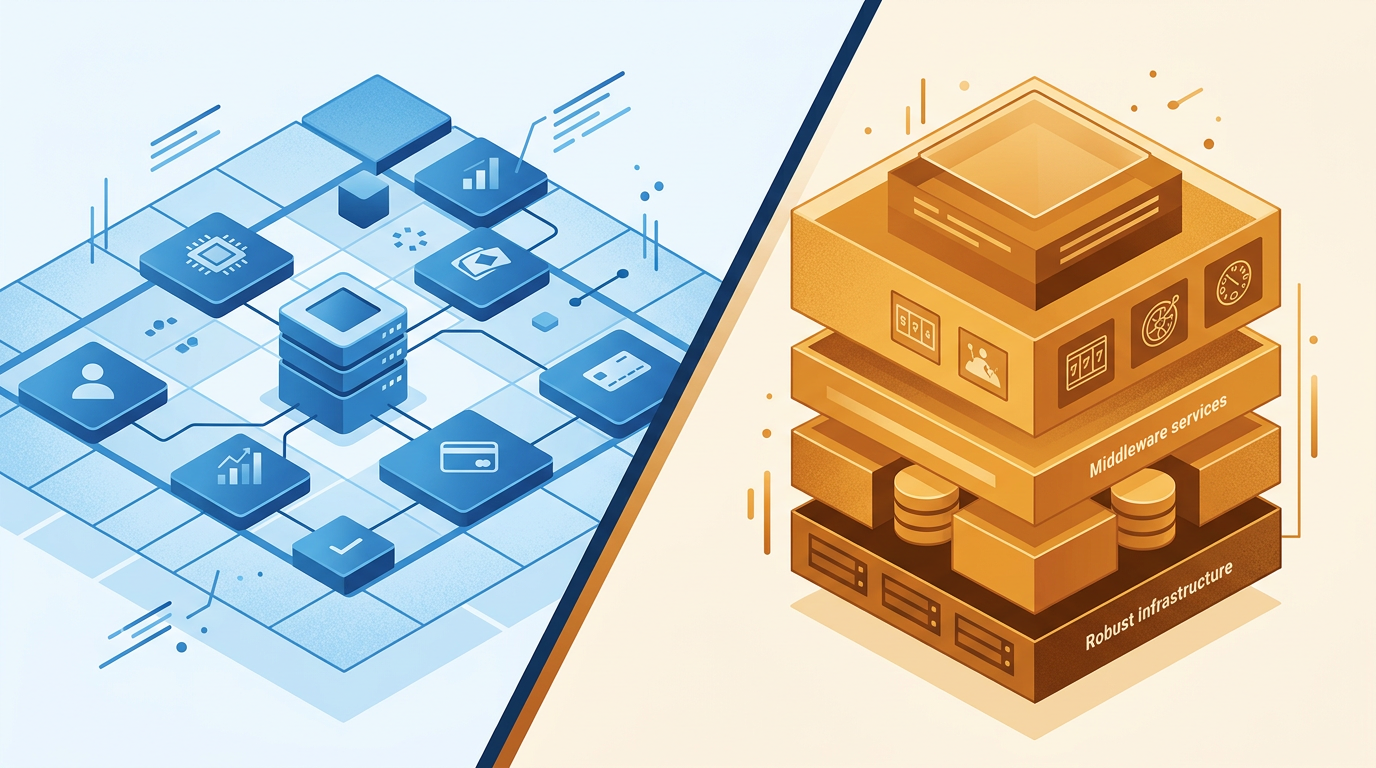
Choosing between GAN vs Light & Wonder is one of the more consequential technology decisions a US online casino operator can make in 2026. Both companies supply B2B iGaming infrastructure into regulated American markets, but they come at the problem from opposite directions: GAN built its business as a turnkey platform provider for land-based casino groups going online, while Light & Wonder approaches iGaming as a content-first supplier whose remote game server and aggregation layer sit on top of operators' existing player account management (PAM) stacks.
This comparison breaks down how the two US online casino platform providers differ on ownership, technology scope, content, commercial fit and risk, and which type of operator each one suits best.
Quick Verdict
- Choose GAN if you are a land-based casino brand or regional operator that needs a full turnkey stack — PAM, payments, geolocation, compliance tooling and content aggregation — delivered as one licensed system, and you want a partner with a long history of US state-by-state launches.
- Choose Light & Wonder if you already run (or are building) your own PAM and front end, and your priority is premium proprietary slot and table content plus a high-volume aggregation feed that plugs into your existing platform.
- Use both is a realistic outcome for larger operators: a platform from one supplier and content from another is the norm rather than the exception in the US market.
GAN vs Light & Wonder at a Glance
| Criteria | GAN | Light & Wonder |
|---|---|---|
| Core offer | Turnkey iGaming platform (GameSTACK) | iGaming content, remote game server and aggregation (OpenGaming) |
| Ownership | Subsidiary of SEGA SAMMY CREATION (acquisition completed May 2025) | Independent, publicly listed gaming supplier |
| Primary US buyer | Land-based casinos launching online | Established online operators and sportsbooks-turned-casinos |
| PAM / account management | Included | Not the core product; integrates with operator PAM |
| Payments, geolocation, KYC tooling | Included in platform | Handled by operator / third parties |
| Proprietary content | Limited; focus is aggregation | Large first-party slot and table library from land-based franchises |
| B2C exposure | Yes — Coolbet brand (Europe, Latin America, Canada) | No direct consumer online casino brand |
| Typical engagement | Long-term platform licence, revenue share | Content revenue share, per-game or aggregation deals |
Ownership and Strategic Position
The biggest structural change in this comparison is GAN's ownership. SEGA SAMMY CREATION agreed to acquire GAN in November 2023 and completed the roughly $96 million deal in May 2025 after a lengthy multi-state regulatory approval process. The transaction took GAN private and handed Sega Sammy both the GameSTACK platform and GAN's relationships with US casino operators, as well as its Coolbet consumer brand.
For operators, that matters in two ways. First, GAN no longer faces the quarterly public-market pressure that constrained investment during its years as a listed company. Second, its product roadmap now sits inside a Japanese entertainment group that has openly stated its ambition to build a global gaming business, which could translate into more content — including Sega Sammy IP — flowing into the platform over time. That last point is a reasonable expectation rather than a confirmed roadmap.
Light & Wonder, by contrast, is a large diversified supplier whose iGaming segment is one of three pillars alongside land-based gaming machines and social casino (SciPlay). Its iGaming unit is smaller than its land-based business, but it is growing: the company reported iGaming revenue of $86 million in Q3 2025, up 16% year on year, a record for the division, following $81 million in Q2 2025.
Technology: Turnkey Platform vs Content Engine
GAN GameSTACK
GAN's flagship is GameSTACK, a turnkey internet gaming system licensed to casino operators for regulated real-money play. According to Sega Sammy's own description of the deal, GameSTACK covers account management, payment processing, geolocation and game content aggregation — effectively the full back office an operator needs to go live in a newly regulated US state.
That breadth is GAN's core selling point. A regional casino group with strong local brand recognition but no in-house iGaming engineering team can launch on GameSTACK without assembling half a dozen separate vendors. GAN also carries a sportsbook capability that grew out of the Coolbet acquisition, allowing a single-platform approach to casino and sports where the operator wants it.
The trade-off is flexibility. A turnkey platform imposes more structure on the front end, the promotions engine and the data model than an operator that builds its own stack would accept. Larger operators with mature product teams often find turnkey systems limiting as they scale.
Light & Wonder OpenGaming
Light & Wonder's iGaming business is built around its OpenGaming ecosystem: a remote game server that distributes first-party content alongside titles from partner studios through a single integration. Wagers processed through the platform reached a quarterly record of $26.6 billion in Q2 2025, according to company results covered by iGaming Business, which gives a sense of the scale of play flowing through its pipes.
The value proposition here is content and reach rather than back office. Light & Wonder can take proven land-based franchises and port them online, which is a significant draw in US markets where players recognise brands from the casino floor. Operators plug OpenGaming into their own PAM, meaning they keep control of player data, CRM and front-end experience.
The trade-off is that Light & Wonder does not solve the operator's platform problem. A new entrant still needs a PAM, payments, geolocation and compliance stack from somewhere else.
Content and Game Libraries
Content is where the two providers diverge most sharply.
- Light & Wonder is primarily a content producer. Its first-party portfolio draws on decades of land-based slot and table game design, and its studio network adds third-party titles through the same aggregation feed. For a US operator, this typically means a meaningful share of the lobby can come from one integration.
- GAN is primarily a content aggregator. GameSTACK connects operators to third-party studios rather than relying on a large proprietary library. In practice, a GAN-powered casino can carry Light & Wonder titles through the platform's aggregation layer.
That overlap is important. GAN vs Light & Wonder is not always an either-or decision — the two can be complementary layers of the same stack.
US Market Coverage
Real-money online casino remains legal in only a handful of US states — New Jersey, Pennsylvania, Michigan, West Virginia, Delaware, Connecticut and Rhode Island — which caps the addressable market for both suppliers. Light & Wonder leadership has said it expects state-level iGaming legalization to accelerate, but new state approvals have been slow.
Both companies hold supplier licensing across the major regulated iGaming states. Before signing, operators should verify current licence status in each target jurisdiction directly with the relevant regulator (for example the New Jersey Division of Gaming Enforcement or the Pennsylvania Gaming Control Board), because supplier approvals, renewals and ownership-change filings can shift, as GAN's multi-state approval process for the Sega Sammy deal demonstrated.
Commercial Model and Total Cost
Neither company publishes standard pricing, and commercial terms vary heavily by operator size and market. The general patterns are:
| Cost driver | GAN | Light & Wonder |
|---|---|---|
| Upfront integration | Platform setup and state launch fees (estimate: higher, as the full stack is delivered) | Single integration to OpenGaming (estimate: lower, content-only) |
| Ongoing fees | Revenue share on platform GGR | Revenue share on content GGR |
| Hidden costs | Customisation limits, migration cost if switching later | Separate PAM, payments and compliance vendors |
| Lock-in risk | Higher — platform migrations are complex | Lower — content can be switched in or out |
The headline point: a turnkey platform consolidates costs but raises switching costs, while a content-only relationship keeps flexibility at the expense of more vendor management.
Risks to Weigh
GAN - Post-acquisition integration: roadmap priorities under new ownership are still settling, and operators should seek contractual commitments on support levels and product investment. - Platform concentration: if your whole iGaming business runs on one vendor, outages or regulatory issues at that vendor are existential.
Light & Wonder - Segment priority: iGaming is a smaller share of group revenue than land-based gaming, so capital allocation may favour other divisions. - Stack fragmentation: content-only deals push integration, compliance and data-reconciliation work onto the operator.
Summary: Which Provider Fits Which Operator?
GAN suits: - Tribal and commercial land-based casinos launching their first online product - Regional brands that want one accountable partner for launch in a new state - Operators that prefer outsourcing platform engineering entirely
Light & Wonder suits: - Operators with their own PAM or a platform from another vendor - Brands competing on lobby quality and recognisable land-based titles - Sportsbook-first operators adding or expanding online casino verticals
FAQ
Is GAN still a publicly traded company?
No. SEGA SAMMY CREATION completed its acquisition of GAN in May 2025 after receiving the required state gaming approvals. GAN now operates as a private subsidiary of the Sega Sammy group, including its GameSTACK B2B platform and the Coolbet consumer brand in Europe, Latin America and Canada.
Can an operator use both GAN and Light & Wonder?
Yes, and it is a common setup. GAN's GameSTACK is a platform that aggregates third-party content, while Light & Wonder is primarily a content supplier through OpenGaming. An operator can run its casino on GameSTACK and still offer Light & Wonder slots and table games in its lobby through aggregation.
Which provider is better for a new US state launch?
For an operator without an existing iGaming stack, GAN is usually the faster route because GameSTACK bundles account management, payments, geolocation and aggregation in one licensed system. Light & Wonder is a stronger fit when the operator already has a platform and needs premium content on day one.
How big is Light & Wonder's iGaming business?
Light & Wonder reported record iGaming revenue of $86 million in Q3 2025, up 16% year on year, and processes tens of billions of dollars in wagers per quarter through its platform. It remains smaller than the company's land-based gaming segment but is one of its faster-growing units.
Final Verdict
In the GAN vs Light & Wonder decision, the right answer depends on what your business is missing. If you need a complete, licensed online casino platform and would rather not assemble vendors yourself, GAN's GameSTACK — now backed by Sega Sammy's balance sheet — is the more direct solution. If your platform is already in place and your competitive edge will come from the lobby, Light & Wonder's content engine and OpenGaming aggregation offer more upside with less lock-in.
For most mid-sized and large US operators, the pragmatic path is to treat them as layers rather than rivals: pick the platform that fits your engineering capacity, then negotiate content deals on the strength of player demand. Whichever route you take, validate current state licensing, service-level commitments and exit terms before signing — those details will matter far more over a five-year contract than any headline feature list.
Source: iGaming Pulse Editorial Desk

Illia Lisovskyy
Senior Editor
Member of the iGaming Pulse editorial team. Covering industry news, analysis, and B2B developments across the global iGaming sector.