Minnesota Becomes First State to Ban Prediction Markets — Federal Regulators Sue Same Day
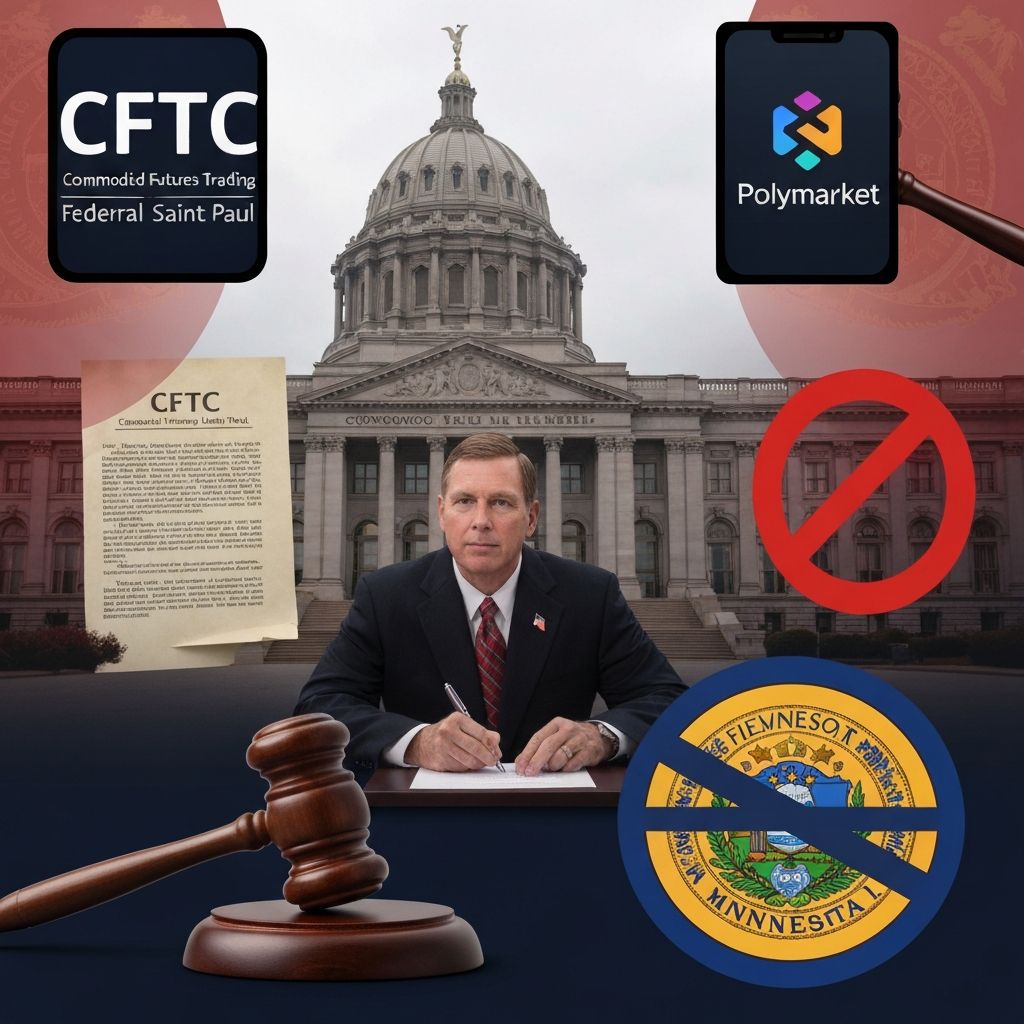
Minnesota has crossed a threshold that no other US state had reached before. Governor Tim Walz signed SF4760 into law on May 18, 2026 — a public safety omnibus bill that, buried within its provisions, contains the United States' first explicit state-level ban on prediction markets. Platforms including Kalshi, Polymarket, and Robinhood's prediction market product now have until August 1 to exit Minnesota or face felony charges.
The Commodity Futures Trading Commission did not wait. Within hours of the governor's signature, the agency filed a federal lawsuit in the US District Court for the District of Minnesota, seeking to block the law before it takes effect. CFTC Chairman Michael Selig was unambiguous: "This Minnesota law turns lawful operators and participants in prediction markets into felons overnight."
What SF4760 Does
The law amends Minnesota's gambling statutes to classify prediction market event contracts — covering sports outcomes, political events, and entertainment — as illegal gambling products when offered to state residents. Unlike the civil cease-and-desist model deployed by Illinois and Nevada, Minnesota has chosen criminal enforcement as its primary mechanism. Operating a prediction market for Minnesota residents after August 1 carries potential felony charges, a posture designed to compel compliance that civil orders demonstrably failed to achieve elsewhere.
The law makes no distinction between CFTC-registered designated contract markets (DCMs) and unregistered platforms. Kalshi, which holds full CFTC registration and argues it operates as a regulated derivatives exchange subject to federal law, would face the same enforcement as unregistered competitors.
The CFTC's Legal Strategy
The commission's lawsuit rests on three layers of federal preemption. Field preemption argues the Commodity Exchange Act so thoroughly occupies derivative contract regulation that state gambling laws cannot coexist with federal law. Obstacle preemption holds that Arizona's enforcement against CFTC-registered entities frustrates Congress's intent. Impossibility preemption asserts a CFTC-registered DCM cannot simultaneously comply with federal requirements to offer approved event contracts and state requirements to not offer them.
Why It Matters
For iGaming operators and sportsbooks, the Minnesota ban and the CFTC's aggressive counter-suit crystallise the defining regulatory question of 2026: whether prediction markets will ultimately face the same state-by-state licensing burden as traditional sports betting, or whether federal preemption will allow them to operate freely in all 50 states. If the CFTC prevails and establishes exclusive federal jurisdiction, prediction markets would constitute a structurally advantaged competitor — exempt from state licensing costs, tax frameworks, and responsible gambling mandates that regulated sportsbooks have spent years and hundreds of millions of dollars building compliance around. The accumulation of CFTC lawsuits against five states makes a Supreme Court hearing increasingly likely within two to three years, making this the highest-stakes regulatory fight in US gambling since PASPA's repeal.
James Whitfield
Editor-in-Chief
Member of the iGaming Pulse editorial team. Covering industry news, analysis, and B2B developments across the global iGaming sector.