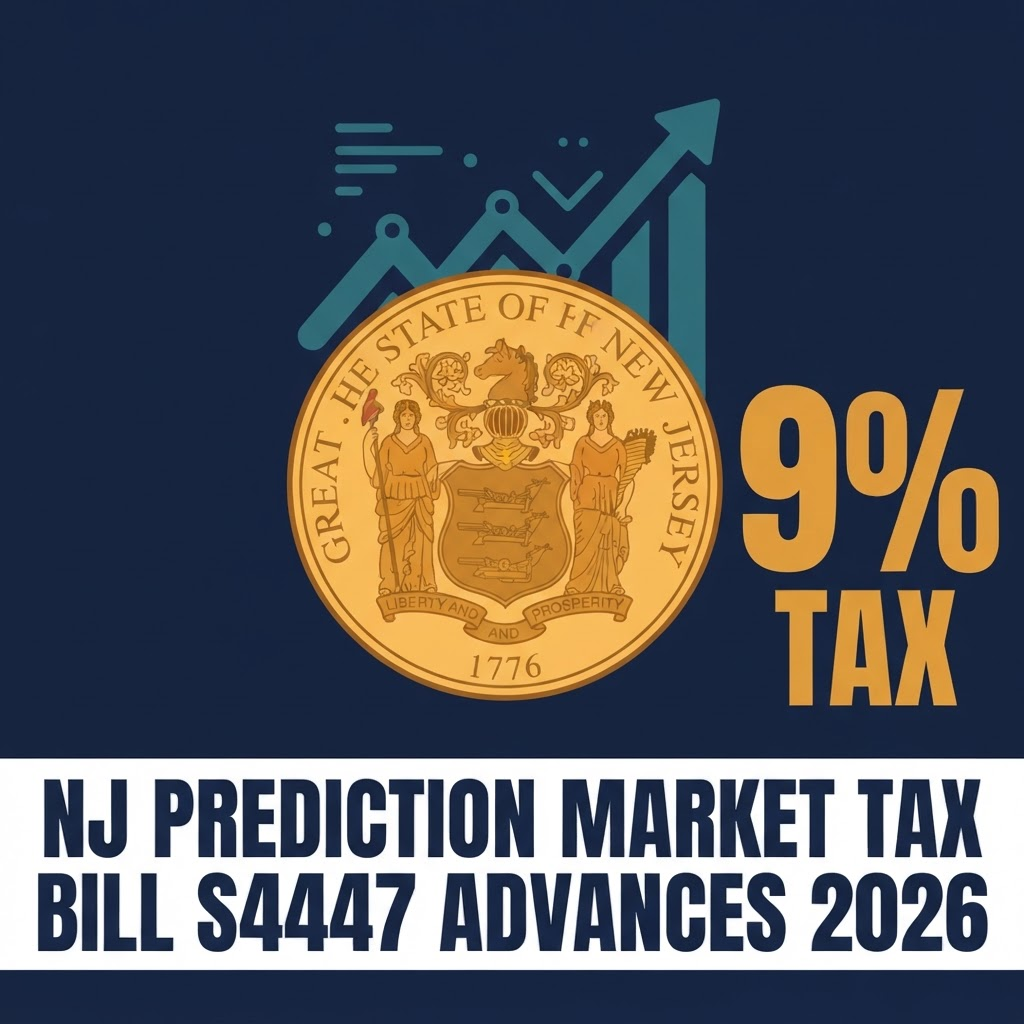
New Jersey Targets Prediction Markets With 9% Gross Income Tax
New Jersey has taken a decisive step toward regulating prediction markets by advancing legislation that would impose a 9% tax on gross income generated by operators conducting business within the state. The revised bill, designated S4447, reflects a measured approach to taxation while acknowledging the rapidly growing prediction market sector.
Context
Prediction markets have exploded in popularity and transaction volume over the past 18 months, driven by increased consumer interest in event-based wagering, major sporting events, and political outcomes. The sector generated over $50 billion in notional volume globally in June 2026 alone, with platforms like Kalshi commanding substantial market share.
New Jersey, traditionally a leader in iGaming and sports betting regulation, has watched this growth with increasing interest. Earlier iterations of the taxation proposal were significantly more aggressive, approaching or exceeding 15–20% tax rates. The revised S4447 represents a compromise position that acknowledges operator concerns about profitability while securing state revenue.
What This Means
The 9% gross income tax positions prediction markets somewhere between traditional casino gaming (typically 8–10% state tax) and sports betting (often lower due to federal frameworks). This alignment suggests New Jersey regulators view prediction markets as fundamentally similar to casino gaming rather than as a distinct financial instrument.
For operators, the 9% rate is substantially more favourable than some initial proposals but still represents a significant compliance cost. Gross income taxation — applied before operational expenses are deducted — is particularly stringent for platforms with thin profit margins or high customer acquisition costs.
The New Jersey initiative marks the first major state-level tax specifically targeting prediction markets and is likely to trigger copycat legislation in other large US states. Pennsylvania, Illinois, and New York are the most probable early adopters, given their established online gaming regulatory frameworks and appetite for gaming-related tax revenue. Prediction market operators must now model multi-state tax scenarios into their US expansion planning.
What to Watch
Monitor New Jersey Assembly and Senate floor votes on S4447. Track regulatory filings from major prediction market platforms — Kalshi, Polymarket, and others — for statements on S4447's commercial impact and any lobbying activity directed at softening gross income taxation.
Source: Casino.org. Published 2026-07-08.
Source: Casino.org

Illia Lisovskyy
Senior Editor
Member of the iGaming Pulse editorial team. Covering industry news, analysis, and B2B developments across the global iGaming sector.