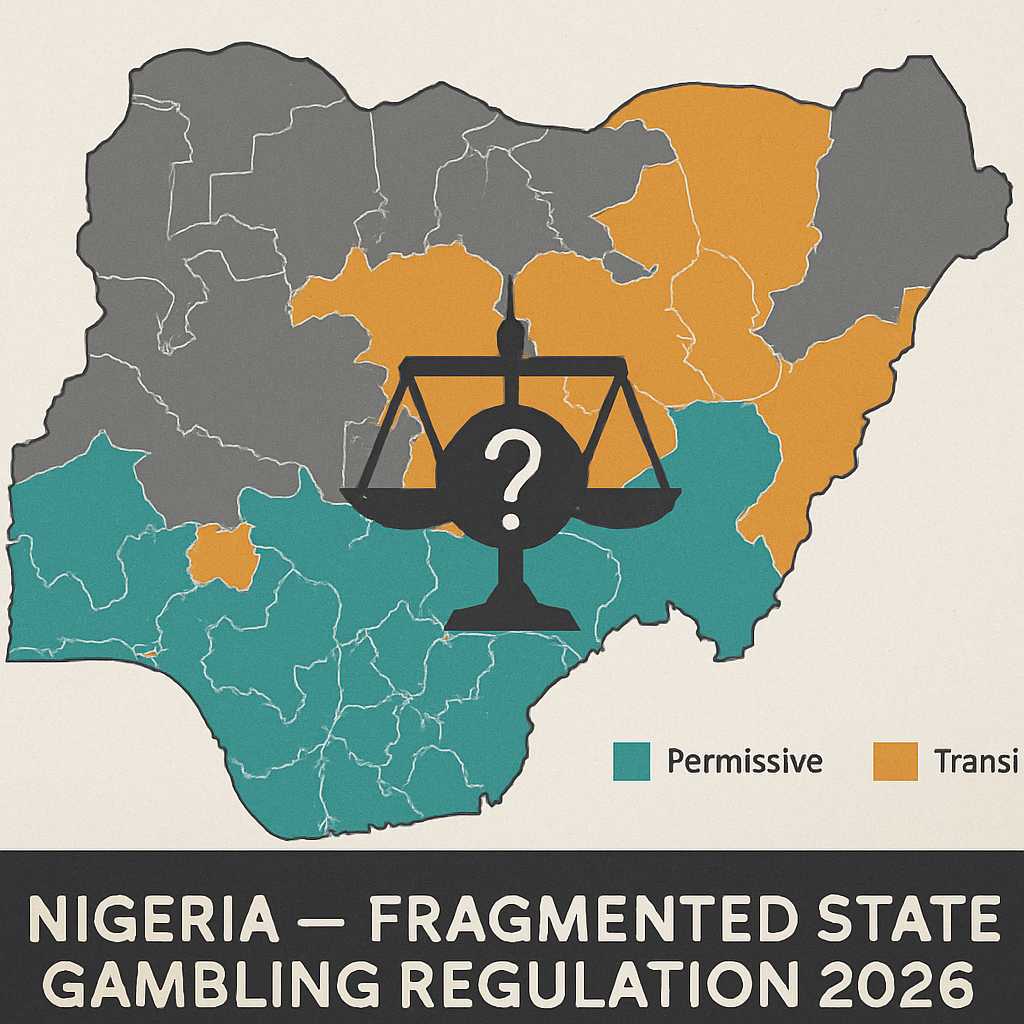
Nigeria's Gambling Regulatory Landscape Remains Fragmented Amid Religious and Political Divisions
Nigerian states are actively reshaping their gambling regulatory frameworks following a landmark 2024 Supreme Court decision that fundamentally altered the legal landscape for gaming and betting. However, significant religious, cultural, and political divisions are creating substantial regulatory fragmentation and uncertainty across the country.
Context
In 2024, Nigeria's Supreme Court issued a ruling with far-reaching implications for gambling regulation at the state and federal levels, clarifying jurisdictional boundaries and potentially opening regulatory pathways that had previously been restricted. Following this ruling, multiple Nigerian states have announced or implemented new gambling licensing regimes and regulatory frameworks.
However, Nigeria's complex religious and cultural landscape is significantly complicating uniform regulatory implementation. Northern Nigeria, with its predominantly Muslim population and stronger influence of Islamic law principles, has historically maintained stricter prohibitions on gambling. Southern Nigeria, with more diverse religious demographics and longstanding gaming traditions, has been more permissive. This divide is now manifesting in divergent state-level regulatory approaches.
What This Means
For international operators and service providers seeking to enter the Nigerian market, the current regulatory environment presents both opportunity and risk. States moving toward formal licensing frameworks represent genuine market entry opportunities, while the northern states' continued restrictions create a fragmented national footprint.
Operators cannot implement a single Nigeria market strategy — they must assess state-by-state regulatory status, prioritising southern and coastal states where licensing frameworks are developing fastest. This jurisdiction-by-jurisdiction approach increases compliance costs but is unavoidable given the constitutional structure and cultural realities.
Nigeria remains one of Africa's largest iGaming markets by player volume. The regulatory fragmentation creates a first-mover advantage for operators willing to navigate the complexity, as those establishing relationships with state regulators early will be better positioned when frameworks mature and competition intensifies.
What to Watch
Track individual state regulatory announcements and licensing regime publications over the next 12 months. The states that move first to establish formal, transparent licensing processes will attract the most credible international operator interest. Federal-level coordination efforts — or their absence — will also indicate whether Nigeria is moving toward a unified framework or permanently entrenching the state-by-state patchwork.
What this means for B2B outreach: Nigeria's regulatory complexity creates demand for localised compliance advisory services, state-by-state market entry consulting, and technology infrastructure that can adapt to divergent regulatory requirements across a single country. Vendors with deep African market expertise and regulatory navigation capabilities have a clear competitive advantage in this environment.
Source: iGamingBusiness. Published 2026-06-05.
Source: iGamingBusiness
Marcus De Luca
Regulation Correspondent
Member of the iGaming Pulse editorial team. Covering industry news, analysis, and B2B developments across the global iGaming sector.