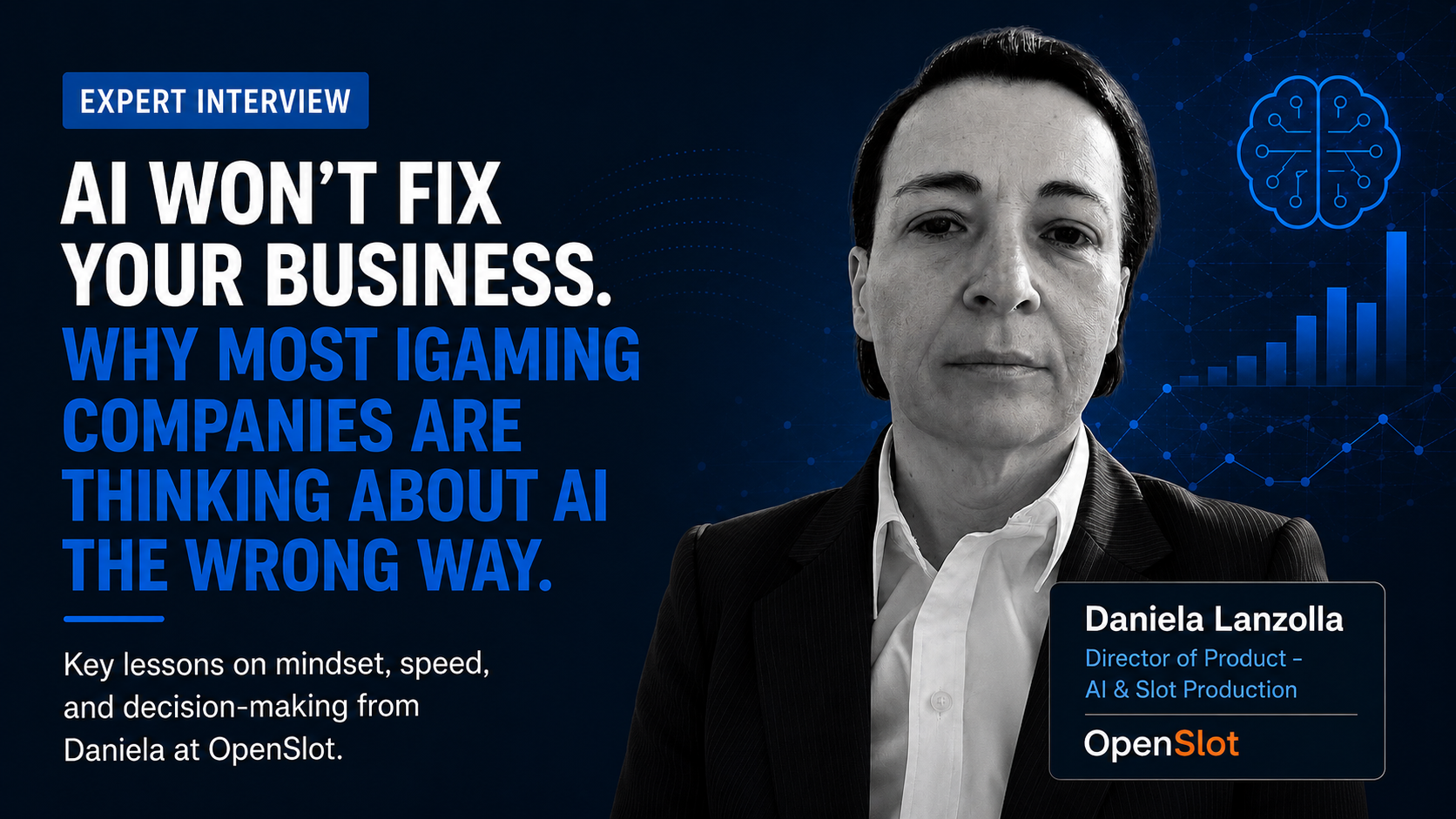
Expert interview with Daniela Lanzolla, Director of Product — AI & Slot Production at OpenSlot.
Artificial Intelligence has become one of the most discussed topics across the iGaming industry. Every conference has multiple AI panels. Every company has an AI strategy. Every executive seems to be exploring how AI can improve efficiency, reduce costs, or accelerate growth.
Yet after speaking with operators, product leaders and technology providers across Europe, one thing has become increasingly clear: the biggest challenge is not the technology itself. It is the mindset behind it.
During a recent conversation with Daniela Lanzolla, Director of Product — AI & Slot Production at OpenSlot, one particular statement stood out:
> "The biggest mistake is when a CEO wakes up one morning and says: everybody should use AI."
At first glance, that sounds reasonable. In reality, it is often where AI adoption starts to fail.
AI Is Not a Project. It Is a Change in How People Work
Many companies approach AI as if it were another software implementation. They buy licences. Run a workshop. Give employees access to ChatGPT. And consider the job done.
But successful AI adoption rarely works that way.
According to Daniela, the most effective transformations start from the bottom up. People need time to experiment. They need to understand how these tools improve their own workflows. They need to see personal value before AI becomes part of their daily routine.
Technology can be introduced overnight. Behaviour cannot.
Why Legacy Companies Have a Harder Time
One of the most interesting parts of our discussion focused on the concept of AI-native businesses. Today, many companies describe themselves as AI-first. However, most established organisations carry significant legacy:
- Existing software infrastructure
- Technical debt
- Established teams and operational processes
- Customer commitments
- Internal politics and decision-making structures
This makes transformation significantly more difficult. A startup launched today can design its workflows around AI from day one. An established operator has to redesign existing systems while continuing to serve customers and maintain performance. These are completely different challenges.
The Most Important AI KPI Is Not Cost Reduction
Like many business leaders, I kept returning to the same question: what are the actual KPIs? How much money can companies save? What ROI should they expect?
The answer surprised me. The first KPI is time.
If a feature that previously required three months can now be tested in two weeks, that alone creates a competitive advantage. If a concept that once took weeks to prototype can now be explored within hours, companies can validate significantly more ideas.
The real value of AI is not automation. It is faster learning. And faster learning leads to better business decisions.
AI-Native Operators Will Change the Industry
Perhaps the most provocative prediction from our conversation was this: if an operator were launched from scratch today, it could potentially operate with a fraction of the headcount required just a few years ago.
Not because AI replaces people. But because AI amplifies productivity. Teams can move faster. Products can evolve faster. Ideas can be tested faster.
As a result, established operators will increasingly compete not only against each other, but also against a new generation of AI-native companies built around entirely different operating models.
Who Will Actually Win?
The companies that benefit most from AI will not necessarily be the ones talking about it the most. Nor will they be the ones buying the newest tools.
The winners will be those that learn faster. Adapt faster. Experiment faster. And redesign their workflows around speed and continuous learning.
AI is not a magic solution. It is an accelerator. And accelerators amplify both strengths and weaknesses.
Which means the most important question for business leaders today is not: "Are we using AI?"
But rather: "Are we ready to work differently?"
Special thanks to Frank Ritter for sharing his experience and insights during our conversation.
Source: iGaming Pulse

Alex Bilyi
Senior Editor
Member of the iGaming Pulse editorial team. Covering industry news, analysis, and B2B developments across the global iGaming sector.