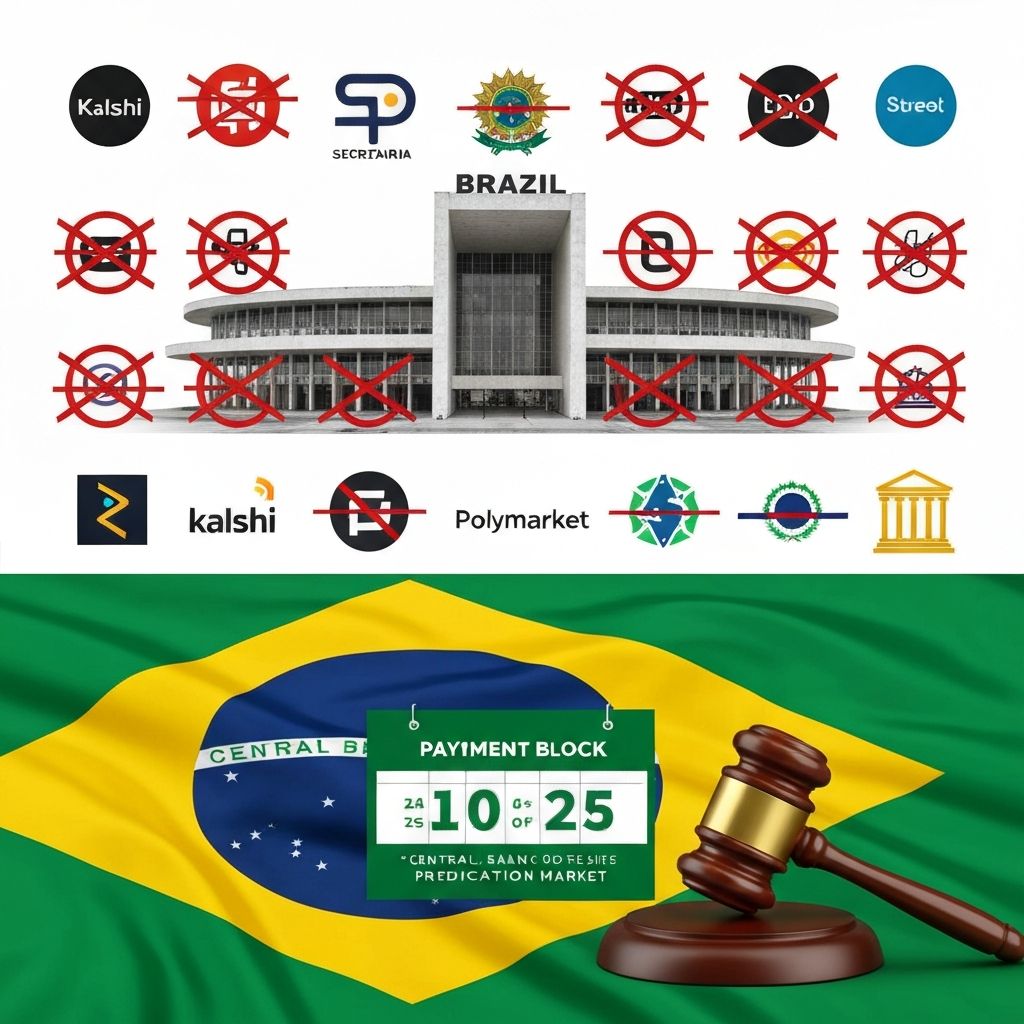
Brazil Shuts Down Prediction Markets — Kalshi and Polymarket Among 27 Platforms Blocked
Brazil's government has executed the world's most sweeping government action against prediction market platforms, blocking at least 27 operators including Kalshi and Polymarket with effect from May 4, 2026 — and setting a Central Bank deadline that will force the country's banking and fintech sector to actively prevent payment flows to blocked platforms.
What Happened
Brazil's National Monetary Council issued regulations prohibiting the offering and trading of derivative agreements whose underlying assets are linked to sports events, political events, and electoral outcomes ��������������������������������������������������������������� the core product categories of Kalshi, Polymarket, and similar platforms. The Secretariat for Prizes and Betting (SPA) is the primary enforcement authority. As a direct consequence, at least 27 prediction market platforms have been blocked for Brazilian users.
The Central Bank of Brazil has been given until May 25, 2026 to publish the specific technical norms that will require Brazilian banks, payment processors, and fintechs to execute financial blocks on the identified platforms — a payment-level enforcement mechanism modelled on Brazil's existing illegal sports betting platform blocking system, which has been used against over 2,000 unlicensed operators since the regulated market launched in January 2025.
Why It Matters
Brazil's approach is more sophisticated than a simple platform ban. By combining a legal prohibition with a payment-level enforcement mandate directed at the banking sector, Brazil is building the same infrastructure that has made its illegal sports betting crackdown unusually effective. When the Central Bank norms are published on May 25, Brazilian banks and fintechs face formal regulatory obligation to block deposits to 27 named platforms — removing the payment pathway that allows grey-market operators to continue operating despite nominal bans.
Brazil's prediction market ban is the world's most comprehensive government action against Kalshi-style platforms to date. With 78 licensed operators and a market that generated billions in GGR in its first year of regulation, Brazil represents a tier-1 commercial market where prediction platforms had been building user bases without licences. For Brazil's licensed operators and their B2B suppliers, the ban removes a direct unregulated competitor from the country's most commercially important wagering audience.
Industry Context
The Brazilian model — legal ban plus payment infrastructure enforcement — is likely to be studied by other regulators as a template for effective prediction market restriction. Unlike domain blocking (which is easily circumvented by VPN) or app store removal (which addresses only mobile access), payment blocking creates a structural barrier at the financial infrastructure level. Brazil's existing experience executing payment blocks against over 2,000 illegal sports betting sites means the administrative machinery for the prediction market enforcement already exists.
James Whitfield
Editor-in-Chief
Member of the iGaming Pulse editorial team. Covering industry news, analysis, and B2B developments across the global iGaming sector.