The Prediction Market Audience Is Enormous, Growing Fast, and Coming from Channels Operators Don't Own
The scale of Kalshi and Polymarket's user acquisition in 2025–2026 has been visible to anyone watching app download charts. But the data published in May 2026 makes the commercial threat to licensed sportsbook operators unusually concrete.
What Happened
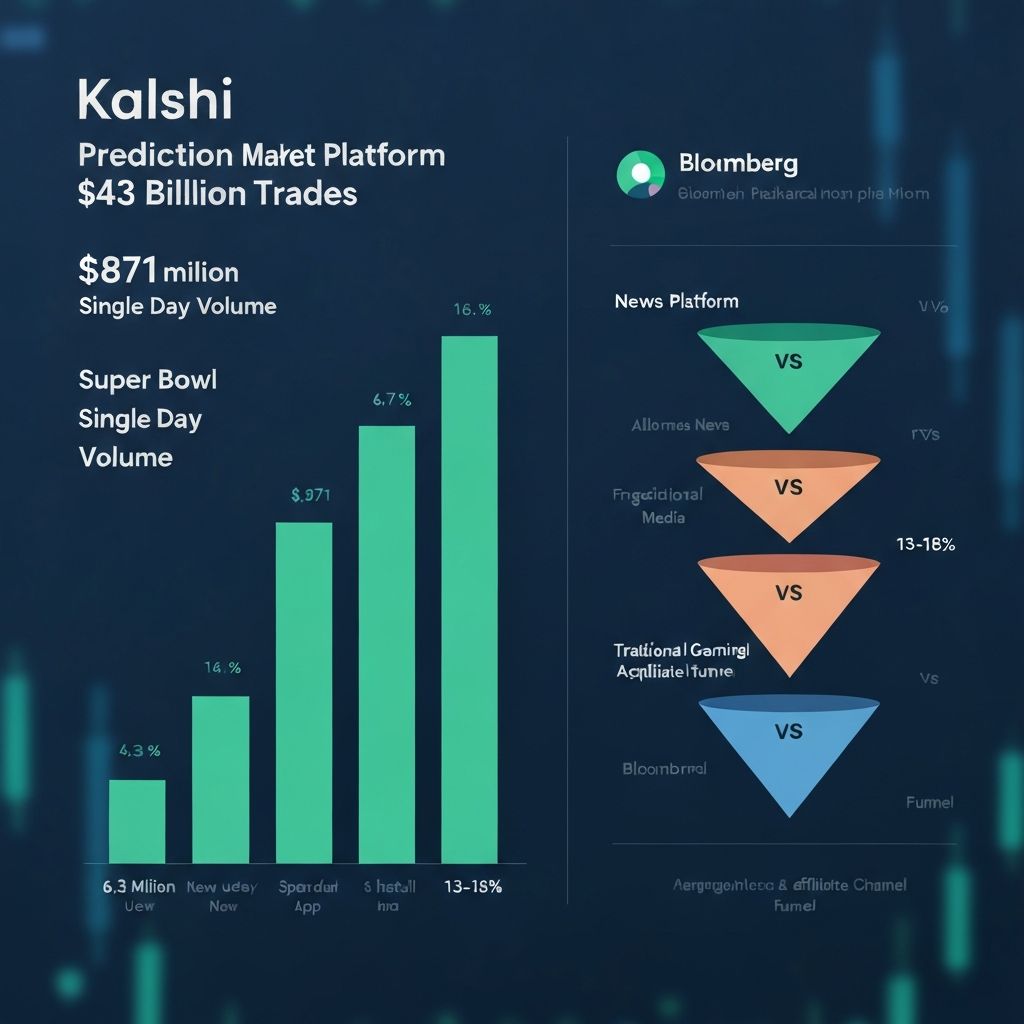
Analysis published via Yogonet International on May 14 compiled the most comprehensive picture of prediction market scale to date. Key figures: Kalshi processed $43 billion in total trades in 2025, with monthly volume growing from less than $100 million in January 2024 to over $20 billion by early 2026. On Super Bowl Sunday 2026 alone, $871 million moved through a single prediction platform in a single day — a volume that rivals or exceeds the handle of all but the largest licensed US sportsbooks on their peak annual event.
Between September 2025 and February 2026, the two largest US sportsbook apps saw new install growth drop 13–18% year-on-year. In the same period, Kalshi added 6.3 million new registered users. The analysis confirmed that prediction market traffic flows primarily from news platforms, financial media tools, and social media communities — not from traditional sports betting affiliate networks, casino review sites, or sportsbook comparison platforms.
Why It Matters
The channel mismatch is the crux of the challenge. Licensed sportsbook operators and their affiliate ecosystems are architected around a specific acquisition funnel: player sees sports betting content → clicks affiliate link → deposits at licensed sportsbook. This funnel works well for sports bettors who already self-identify as gamblers. It does not reach the prediction market audience, who self-identify as informed political and financial analysts and arrive through Bloomberg integrations, Twitter/X financial communities, or news aggregator alerts.
DraftKings' $200–300M prediction market investment and Slotegrator's Predictor product launch are both direct responses to this audience gap. For affiliate networks and media buyers in the iGaming sector, the prediction market audience represents a genuinely new customer segment that existing affiliate traffic strategies cannot reach without a fundamental channel diversification.
Industry Context
The channel mismatch creates a strategic decision point for every major licensed sportsbook: either build or acquire acquisition capability in financial media channels (expensive and unfamiliar), partner with prediction market platforms to co-acquire users (strategically complex), or focus on product superiority and accept that the prediction market audience is a separate market. The data from this analysis suggests operators who assume prediction market users will naturally migrate to licensed sportsbooks are misreading the audience demographic — these users are arriving from different channels and have different product expectations than traditional sportsbook players.
Source: Yogonet International
James Whitfield
Editor-in-Chief
Member of the iGaming Pulse editorial team. Covering industry news, analysis, and B2B developments across the global iGaming sector.