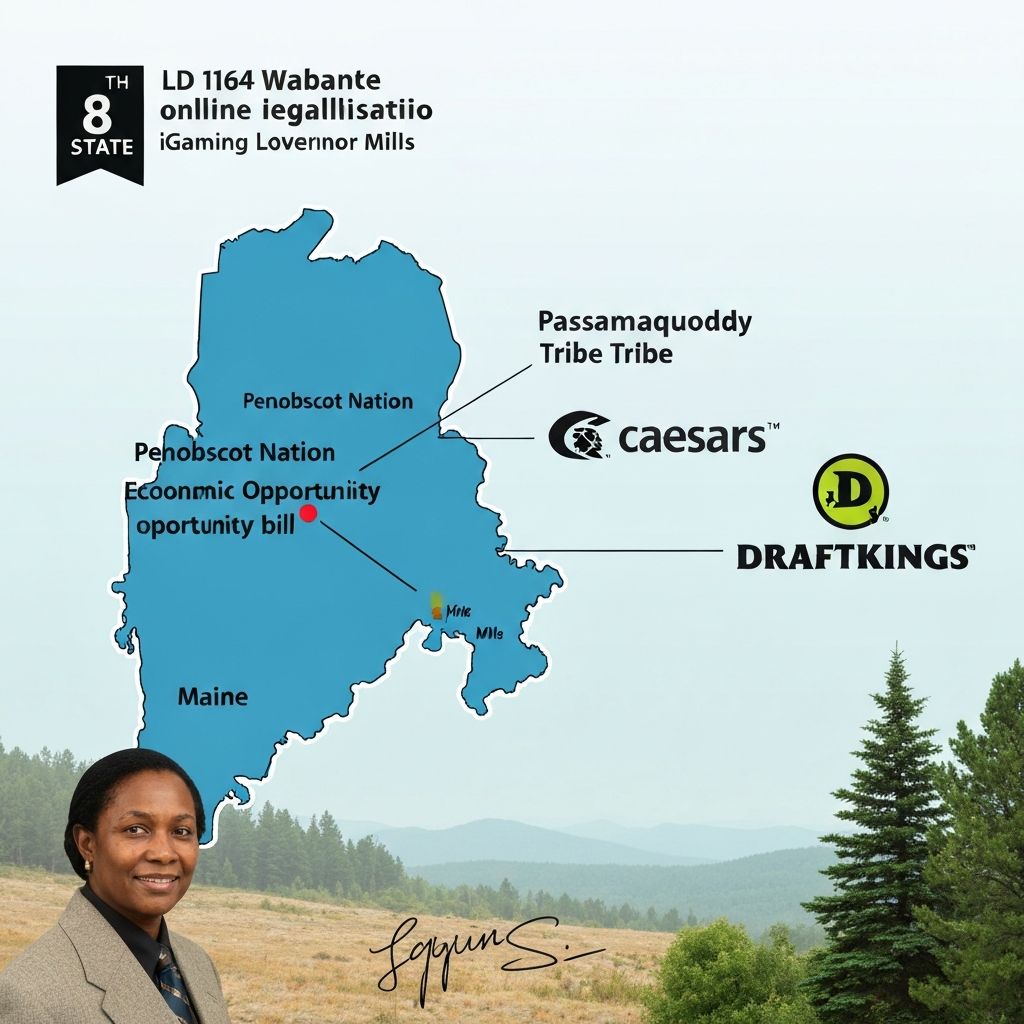
Maine's iGaming Law Is Like No Other US State — Tribal Nations Hold All the Licences
Maine has become the eighth US state to authorise real-money online casino gaming. But the structure of its market is unlike any other iGaming jurisdiction in the country — and it may become the template for tribal gaming in other states where tribal nations hold political leverage over gambling legislation.
What Happened
Governor Janet Mills allowed LD 1164, the Act to Create Economic Opportunity for the Wabanaki Nations, to pass into law without her signature — a political manoeuvre that enacts the legislation while allowing the Governor to maintain formal distance from the gambling expansion. The law authorises Maine's four federally recognised tribal nations — Penobscot Nation, Passamaquoddy Tribe at Pleasant Point and Indian Township, Houlton Band of Maliseet Indians, and Mi'kmaq Nation — to operate online casino gaming for Maine residents.
No commercial operator can hold an independent online casino licence in Maine; all licensed operations must be conducted through a tribal nation or in partnership with one. The law becomes effective approximately mid-July 2026 (90 days after the House session ended April 17), but a full regulated launch is expected in late 2026 or early 2027 pending completion of the regulatory framework. Two commercial operator deals are already confirmed: Penobscot Nation has aligned with Caesars Digital, and the Passamaquoddy Tribe has signed a multi-year agreement with DraftKings.
Why It Matters
Maine's tribal-exclusive model inverts the standard US iGaming structure. In New Jersey, Michigan, Pennsylvania, and every other state, commercial operators apply for licences and tribal nations either participate on equal terms or are excluded. In Maine, tribal nations are the only entities that can hold licences, and commercial operators enter the market exclusively as technology and operations partners — earning service fees rather than direct operator economics.
For the tribal nations, the model is financially transformative: tribal governments capture the operator economics that commercial entities like DraftKings and FanDuel capture in other states. The DraftKings-Passamaquoddy and Caesars-Penobscot deals are the prototypes — they will define the economic terms and governance structure for what tribal-exclusive iGaming looks like when it scales to potentially larger markets.
Industry Context
Maine's market is small by US standards — a state of 1.4 million people — but the tribal-exclusive structure could be replicated in larger states where tribal nations have stronger political relationships with state legislatures. The precedent is particularly relevant in states like California, where tribal nations hold significant political and economic leverage over gambling legislation, and where the tribal gaming sector has historically blocked commercial iGaming expansion. LD 1164 demonstrates that tribal-controlled iGaming is a viable legislative path.
James Whitfield
Editor-in-Chief
Member of the iGaming Pulse editorial team. Covering industry news, analysis, and B2B developments across the global iGaming sector.