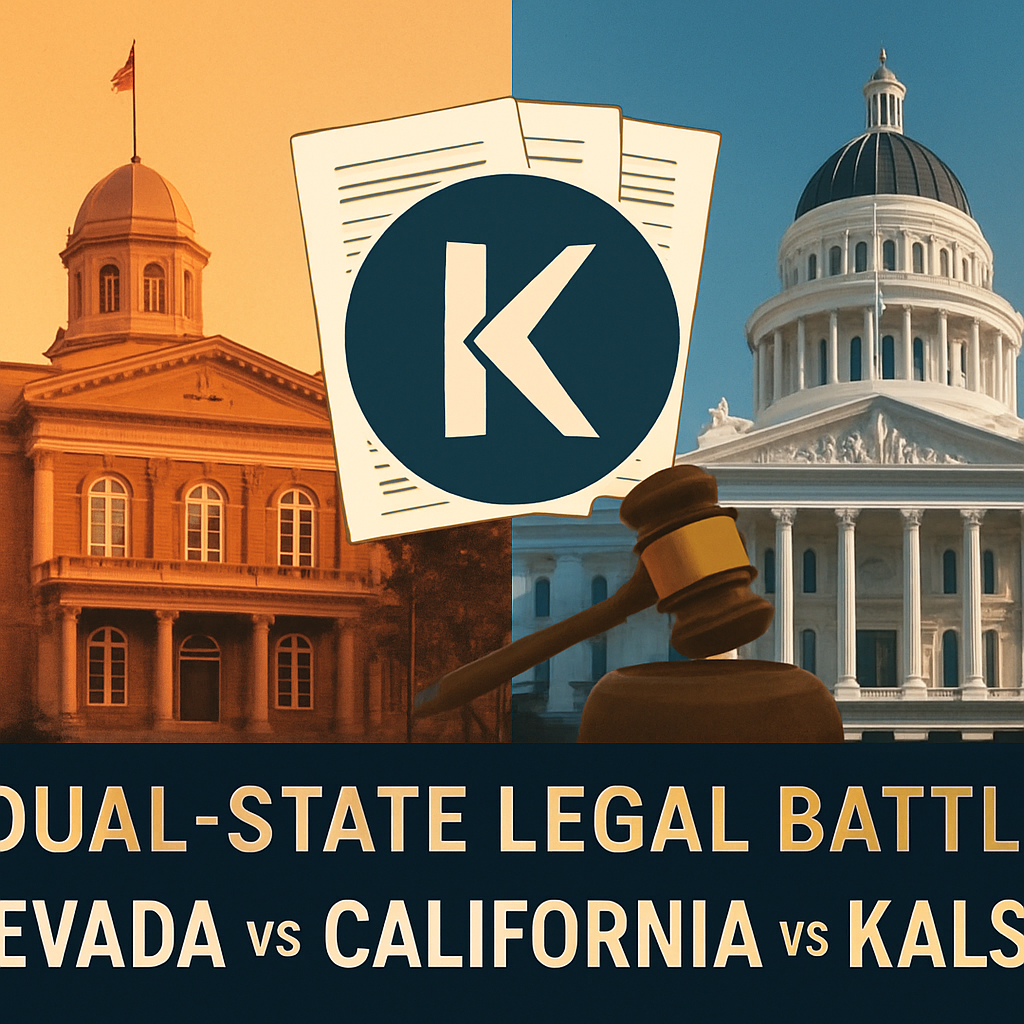
Coordinated State Enforcement Escalates
Nevada and California have launched a renewed push to enforce legal orders against Kalshi, the prediction market platform that has faced regulatory challenges across multiple jurisdictions. The two west-coast states are exerting simultaneous legal pressure, marking a significant escalation in enforcement efforts against the company.
Both regulatory bodies have substantial stakes in the outcome, with implications extending far beyond Kalshi itself. Nevada's Gaming Control Board and California's Department of Justice are pursuing separate but parallel legal tracks, suggesting a coordinated approach to prediction market regulation.
Context
Kalshi has emerged as a controversial player in the US prediction market space, operating at the intersection of gambling regulation, securities law, and commodity futures oversight. The company's event-outcome platform has attracted both retail and sophisticated users seeking to trade contracts on political, economic, and social outcomes.
Previous regulatory challenges have centred on whether Kalshi's offerings constitute illegal gambling under state law, whether they fall under federal commodity futures jurisdiction, or whether they represent unregistered securities. The current enforcement actions represent state-level regulators' determination to establish clear boundaries and compliance requirements — regardless of the separate federal rulemaking process underway at the CFTC.
Neither Nevada nor California has traditionally been passive on gambling matters. Both states maintain robust regulatory frameworks and have demonstrated willingness to pursue enforcement action against operators deemed non-compliant with state law.
What This Means
The dual legal pressure from Nevada and California indicates that state regulators are unwilling to tolerate continued operation without explicit compliance frameworks. The enforcement orders likely specify operational parameters, licensing requirements, or restrictions on user participation that Kalshi must satisfy before continuing to serve residents of these states.
For prediction market operators broadly, this development signals that federal regulatory progress at the CFTC does not pre-empt state enforcement. Even as the CFTC develops its prediction market rulemaking framework, individual states retain enforcement authority under state gaming laws — and Nevada and California have just demonstrated their willingness to exercise it.
Operators in the prediction market sector should treat this as a critical compliance signal: multi-state market access requires state-by-state regulatory engagement, not simply reliance on a single federal licence or registration.
What to Watch
Monitor court proceedings in both Nevada and California for preliminary injunction decisions, compliance deadlines, or settlement terms. If Kalshi enters consent agreements with either state, the specific compliance conditions will define the baseline standard that other prediction market operators must meet to continue serving those markets.
What this means for B2B outreach: State-level regulatory intelligence platforms and multi-jurisdiction compliance advisory firms have a compelling and urgent narrative for prediction market operators. The Nevada-California-Kalshi situation demonstrates that prediction market compliance is a state-by-state challenge requiring dedicated monitoring and rapid response capabilities — precisely the services specialist vendors provide.
Source: iGamingBusiness. Published 2026-06-16.
Source: iGamingBusiness

Illia Lisovskyy
Senior Editor
Member of the iGaming Pulse editorial team. Covering industry news, analysis, and B2B developments across the global iGaming sector.