European Regulators Close Ranks on Prediction Markets
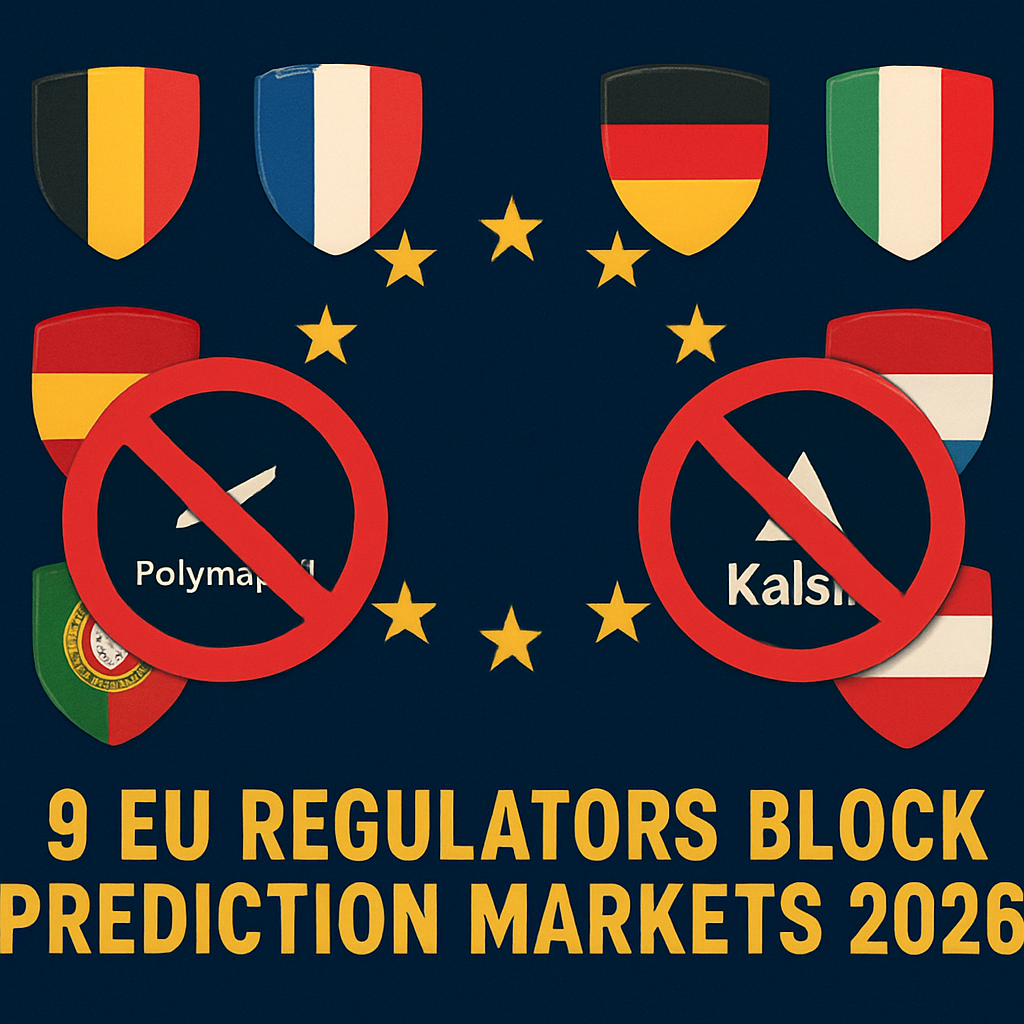
A coordinated enforcement action across nine European nations marks a watershed moment for prediction market regulation. Belgium, France, Germany, Italy, the Netherlands, Poland, Portugal and Spain have aligned their regulatory positions, blocking or restricting access to major unlicensed prediction market operators.
Polymarket and Kalshi, two of the sector's most prominent platforms, have already faced market access restrictions as a result of this coordinated crackdown. The enforcement signals that European regulators no longer view prediction markets as a niche product category exempt from gambling regulation.
Context
Prediction markets have exploded in popularity over the past 18 months, driven by interest in event-based wagering during major global happenings like the 2026 FIFA World Cup. However, most major prediction market operators have operated without formal gambling licences in European jurisdictions, treating prediction contracts as financial derivatives rather than gaming products.
The regulatory ambiguity that allowed this grey-market growth is now closing. European supervisory authorities have determined that prediction markets function identically to sports betting and should be subject to equivalent licensing and consumer protection requirements.
Germany's Federal Financial Supervisory Authority (BaFin) and France's National Gaming Authority (ANJ) led much of the coordination effort, establishing enforcement standards that other nations quickly adopted. The synchronised approach prevents regulatory arbitrage where operators might relocate to permissive jurisdictions.
What This Means
Operators currently active in European markets face an immediate compliance decision. Platforms must either obtain formal gambling licences in each jurisdiction where they operate, voluntarily geofence European users, or exit the market entirely.
For established operators like Polymarket and Kalshi, the European enforcement significantly reduces accessible market size. Europe represents a substantial portion of prediction market trading volume, and the loss of access to France, Germany, Italy, Spain, and the Netherlands alone removes hundreds of millions in potential trading volume.
For B2B service providers and compliance vendors, the crackdown creates structural demand. Prediction market operators seeking to re-enter European markets legally will require licensing support, regulatory affairs advisory, responsible gambling technology, KYC/AML infrastructure, and market-specific compliance tooling — a comprehensive B2B opportunity across multiple service categories.
What to Watch
Monitor whether Polymarket, Kalshi, or other major prediction market platforms initiate European licensing processes. The first platform to successfully secure licences across multiple European jurisdictions will capture a significant first-mover advantage in the newly legitimised European prediction market sector.
Source: iGaming Business. Published 2026-06-19.
Source: iGaming Business
James Whitfield
Editor-in-Chief
Member of the iGaming Pulse editorial team. Covering industry news, analysis, and B2B developments across the global iGaming sector.