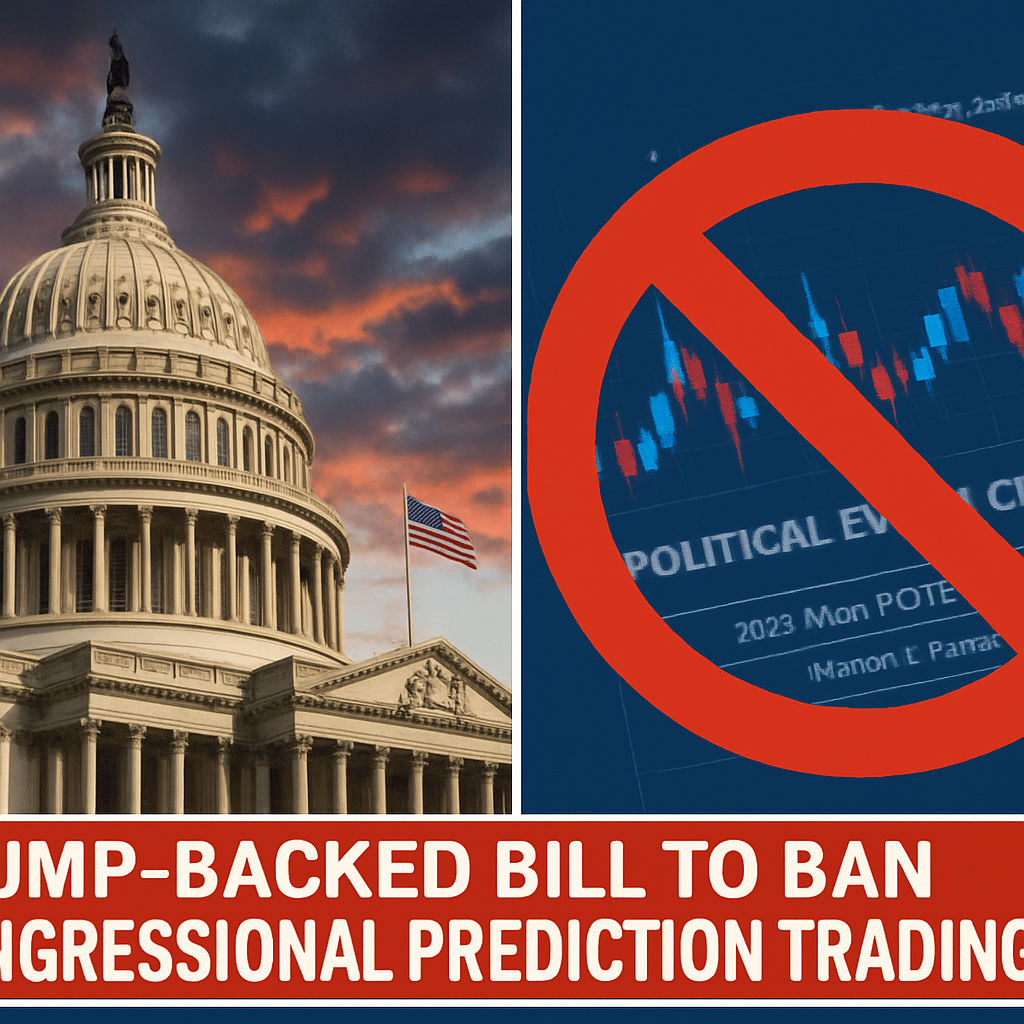
Trump Administration Moves to Ban Congressional Prediction Market Trading
Rep. Bryan Steil (R-Wisconsin) has introduced legislation aimed at prohibiting members of Congress and their families from trading on prediction markets related to political events. The proposal has secured support from President Donald Trump and Speaker of the House Mike Johnson, signalling significant political momentum for restrictions on political prediction market activity.
The bill represents the first major U.S. legislative effort specifically targeting prediction markets and reflects growing concerns about the potential for insider trading and conflict of interest when elected officials have financial stakes in political outcomes they help shape.
Context
Prediction markets have achieved mainstream adoption over the past 24 months, particularly as platforms like Polymarket, Kalshi, and DraftKings Predictions have made trading on political events accessible to retail users. Political prediction contracts — covering election outcomes, policy passage likelihood, and appointment confirmations — have generated hundreds of millions in trading volume.
However, this growth has surfaced regulatory and ethical concerns around Congressional participation. Members of Congress possess material non-public information about legislative outcomes, committee actions, and regulatory decisions that could inform prediction market trades. A representative voting on healthcare legislation, for example, might benefit financially from a prediction market position on healthcare policy outcomes.
The bill has received support from an unusual political coalition. Both progressive Democrats concerned about corruption and conservative Republicans focused on market integrity have voiced support for some form of Congressional prediction market trading restriction.
What This Means
For prediction market operators, legislation targeting Congressional trading has multiple implications.
Direct revenue impact: Political event contracts have historically been among the highest-volume prediction categories. Restrictions on Congressional participation may reduce market depth and liquidity, as elected officials and their networks represent a non-trivial portion of trading activity in political markets.
Broader regulatory precedent: The bill's focus on insider trading and conflict of interest creates a regulatory framework that could extend to other categories where information asymmetry exists. Financial markets, regulatory decisions, and corporate events all present similar insider-information risks.
Legitimacy trade-off: Paradoxically, Congressional endorsement of prediction market regulation — by passing a bill rather than simply banning the sector — implicitly legitimises prediction markets as a regulated financial product rather than illegal gambling. This could accelerate the CFTC rulemaking process and create a clearer federal regulatory pathway.
What to Watch
Monitor Senate committee proceedings on the bill and any amendments that broaden or narrow the scope beyond Congressional members. A final bill that focuses narrowly on elected officials would be commercially manageable for prediction market operators; one that expands to government employees or regulated industries would create much larger compliance obligations.
Source: Casino.org. Published 2026-06-19.
Source: Casino.org
Marcus De Luca
Regulation Correspondent
Member of the iGaming Pulse editorial team. Covering industry news, analysis, and B2B developments across the global iGaming sector.